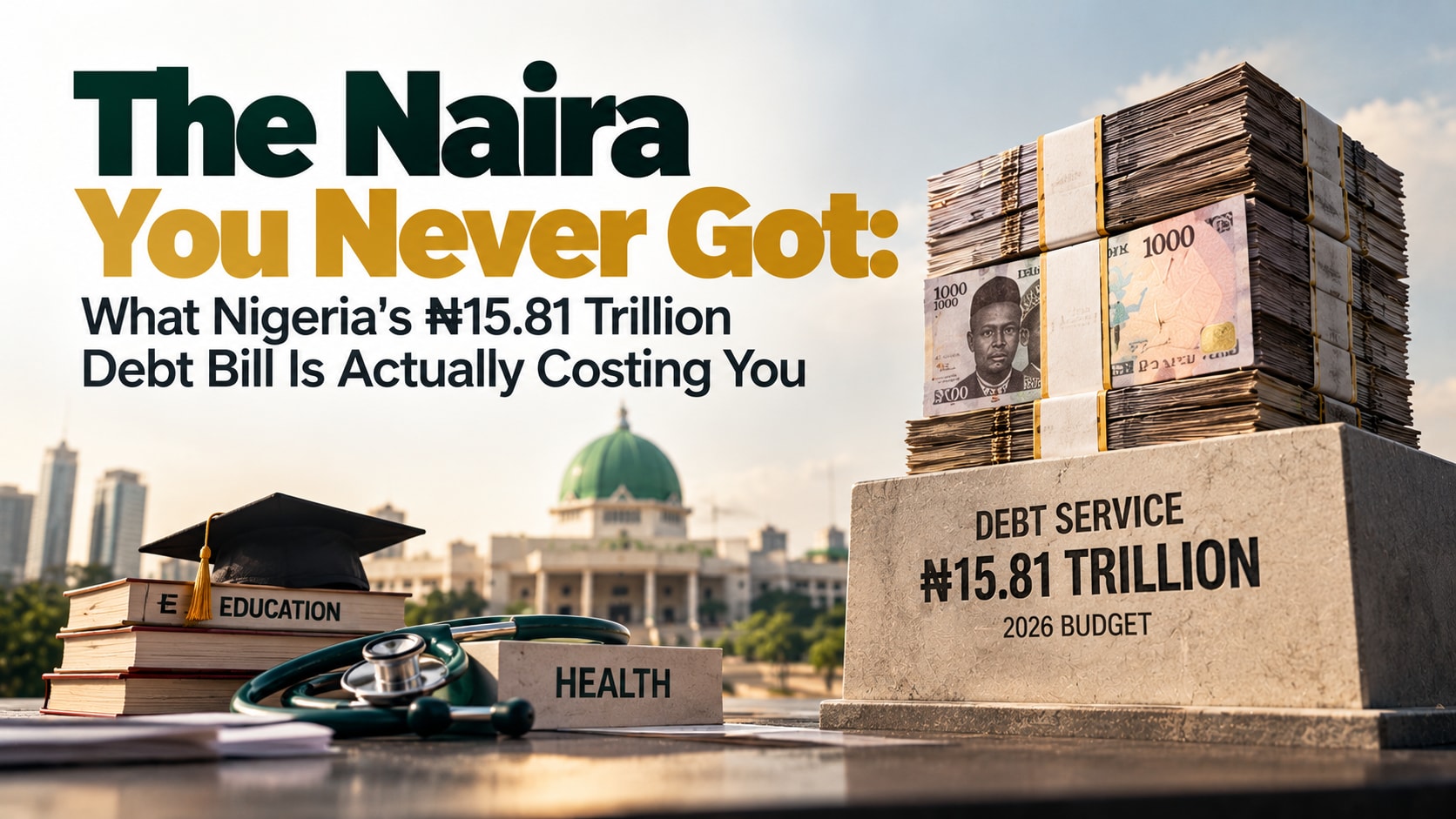
Nigeria's 2026 budget sets aside ₦15.81 trillion to service debt already owed, about 23% of the entire ₦68.3 trillion budget. In the same document, health gets ₦2.48 trillion. Education gets roughly ₦3.52 trillion.
Put those last two together, and Nigeria still spends more on debt service alone than on health and education combined, by a wide margin. This is not a comparison chosen to shock. It is the arithmetic of the budget the National Assembly actually passed.
A Number With an Address
There is a habit of talking about debt service as an abstraction, trillions of naira disappearing into a line item nobody can picture. It helps to make it concrete.
Nigeria has, for two decades, been committed to the Abuja Declaration, a continental pledge to direct 15% of national budgets to health. Meeting that target in 2026 would require roughly ₦8.7 trillion for health alone. The actual allocation, ₦2.48 trillion, leaves a shortfall of more than ₦6 trillion.
Now place that ₦6 trillion shortfall next to the government's own account of its debt costs: between June 2023 and December 2025, Nigeria's debt-service bill grew by ₦10.61 trillion, about ₦4.14 trillion more than the ₦6.47 trillion the government spent on strategic infrastructure across the same period.
The growth in what Nigeria pays its lenders in roughly two and a half years is close to the entire annual shortfall in what it fails to spend on health. The money did not vanish. It has an address, and that address is a bondholder's account, not a hospital's budget.
A Loan Shark at the Family Table
The easiest way to picture this at home: a household where, every payday, the moneylender is paid first, in full, before the children eat.
The household is not broke. It has income. But the order of payments means the people with the least power over the original decision, the ones who did not take the loan, eat last and eat least.
Nigeria's fiscal order of operations works the same way. Debt service is a first-charge obligation: it gets paid whether or not the harvest was good, whether or not oil prices held, or whether or not a state hospital ran out of essential drugs that quarter.
Health and education compete for whatever is left after that first charge is settled.
The Ratio Nobody States Plainly
Here is the comparison in its cleanest form: for every naira Nigeria's 2026 budget commits to debt service, it commits roughly 38 kobo to health and education combined.
Framed the other way, debt service alone is a little over two and a half times the combined health and education vote.
That ratio, precisely stated and sourced to the same 2026 appropriation figures the government has itself published, should be repeatable by a journalist, a National Assembly member, or a market trader without an economics degree, because the underlying math is simple. It is just rarely said out loud in one sentence.
This Is Not a New Story, Just an Underreported One
Nigeria's health financing gap against the Abuja Declaration is not new; it has persisted since the target was set more than two decades ago, and health's share of federal spending has stayed below 6 % of the total budget in every year since 2023, against a 15 % benchmark.
What is worth stating plainly is how directly debt has become the reason that gap keeps failing to close: debt service is growing faster, in absolute naira terms, than the health and education allocations combined are growing, which means even nominal increases in health spending are being outpaced by the cost of debt already contracted in the past.
The Fix Already Has a Precedent
Nigeria does not need a new institution to fix this; it needs a floor.
A statutory minimum share of the budget for health and education, which protected the way debt service itself is effectively protected as a first-charge obligation, would at least stop the two from competing for whatever is left over after interest is paid.
This is not a radical proposal. Countries with far less fiscal room than Nigeria have ring-fenced minimum social-spending shares in law precisely because voluntary annual allocations lose that competition every single year.
What This Means for the Person Reading This
If you are waiting for a rural health centre to be restocked, a public school to hire more teachers, or a state hospital to fix its diagnostic equipment, the ₦6 trillion shortfall against the Abuja Declaration is not a statistic. It is the reason the wait continues.
Nigeria found ₦10.61 trillion in new money for debt service in under three years. Finding a comparable, protected floor for the sectors that keep citizens alive and educated should not be a harder political problem than that.
The Centre for Inclusive Social Development (CISD) is a non-profit research and advocacy organisation working to advance inclusive governance, gender and social equity, civic technology, and sustainable livelihoods across Nigeria and sub-Saharan Africa. Through rigorous research, coalition-building, and public-interest storytelling, CISD amplifies the voices of marginalised communities and holds power accountable.
Learn more at cisdnigeria.org or follow us on social media.
How to cite this article
Tobechukwu Ezeuko. (2026, October 14). The Naira You Never Got: What Nigeria's ₦15.81 Trillion Debt Bill Is Actually Costing You. CISD Insights. Centre for Inclusive Social Development. Retrieved from https://cisdnigeria.org/article/the-naira-you-never-got-what-nigerias-1581-trillion-debt-bill-is-actually-costing-you/.