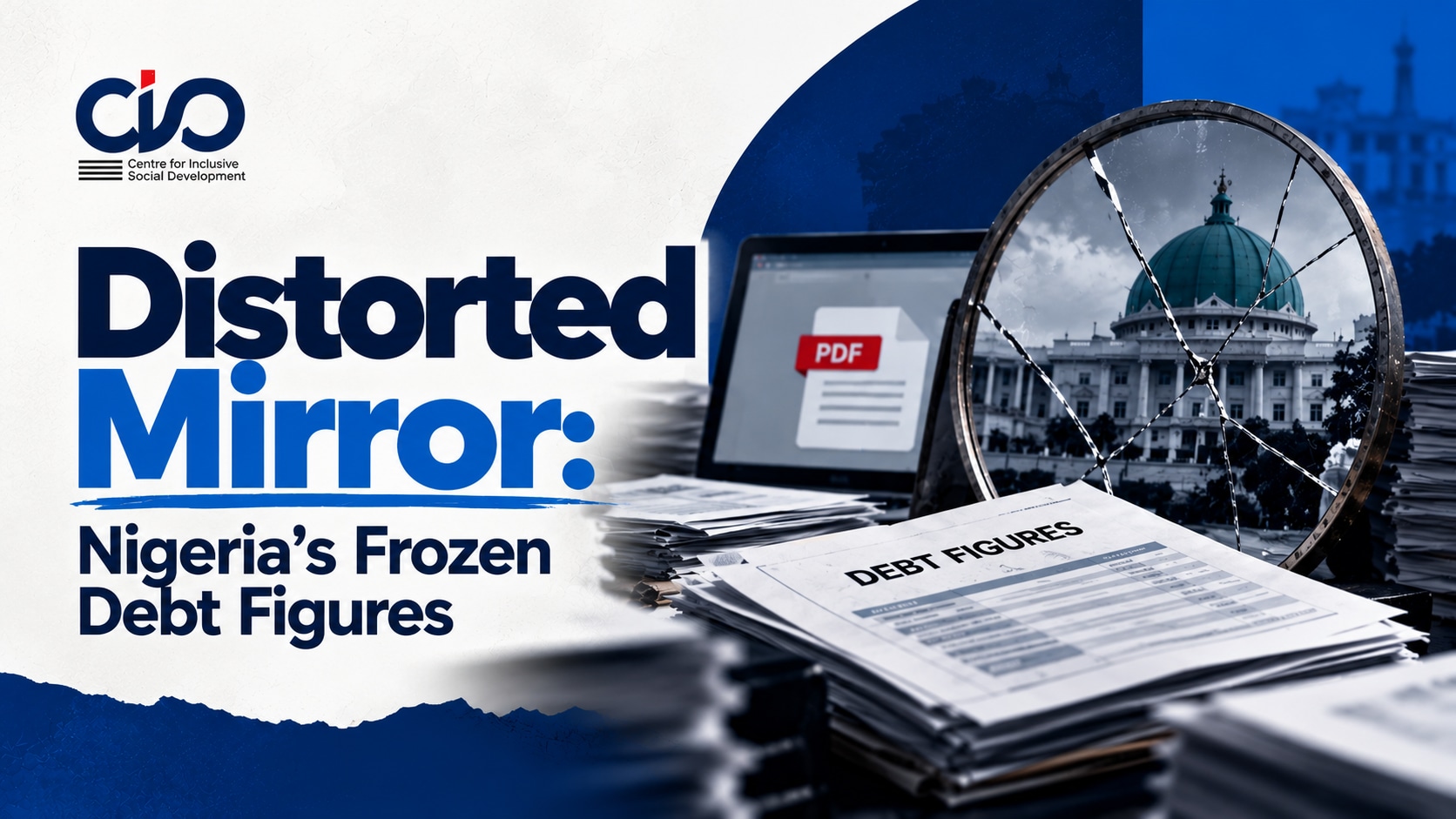
For a developing country desperate to build trust and attract global investment, handing citizens a static PDF and calling it transparency is a special kind of government gaslighting.
Every quarter, Nigeria’s Debt Management Office (DMO) does the exact same thing: it dumps a PDF document onto its website. This file is formatted like a printed piece of paper rather than a searchable database. It gives total figures without any connecting links or underlying data, making it almost impossible for an everyday reader to verify the maths.
Technically, this basic upload meets the International Monetary Fund’s (IMF) minimum rules for reporting data on time. But meeting a basic rule was never supposed to be the final goal; it was meant to be the absolute minimum starting point on the way to continuous improvement. Nigeria met that basic starting line decades ago and simply stayed there.
A Static PDF in a Real-Time Financial World
It is surprising that Nigeria still releases national debt data the same way a small local business might show its accounting books to a single auditor, meant to be read once, closed, and filed away in a drawer.
In an age where global financial markets move in real time, Nigeria’s debt tracking behaves like a loose stack of papers dropped on the floor, making it impossible to see how the numbers connect into a coherent picture.
This isn't just an inconvenience for researchers and economists; it is the exact mechanism that weakens public accountability at its roots. A lawmaker cannot question a debt figure if they cannot see the pieces that make up the total.
Following the Money: From Loan to Project
Consider a simple scenario: Nigeria borrows $1 billion to build a hospital. A journalist wants to follow that money from the initial loan to the contractor and finally to the finished hospital wing.
They check NOCOPO, Nigeria’s official open-contracting platform, which is supposed to show who got paid to lay the bricks, and find no record linking those construction payments to the $1 billion loan.
There are no repayment schedules, no grace periods, and no details on pledged collateral. A billion dollars enters and leaves the government's hands without those crucial details ever appearing on a public page.
Even for basic public procurement details, government agency compliance with reporting platforms sits around 27%.
When critics point to “ghost projects”, roads, schools, and clinics that were paid for on paper but were never actually built, it becomes clear why this happens. It’s because the reporting system is designed in a way that makes it look like nothing was ever built. Verifying the truth becomes almost impossible for anyone outside government circles.
The Financial Cost of Missing Information
This lack of transparency carries a heavy financial price tag that everyday citizens end up paying for.
When a government cannot clearly prove its own books, international lenders stop trusting it with their money. In basic economics, when risk goes up, lenders charge higher interest rates. But if risk and uncertainty become too high, higher rates aren't enough; lenders simply walk away.
Think of it like a bank dealing with a customer who frequently bounces cheques. The bank doesn't just raise the customer's fees; it closes their account altogether because it can no longer trust their financial statements.
Credit rating agencies react to this missing data in a quiet but damaging way. When numbers are absent, agencies do not give Nigeria the benefit of the doubt; they treat secrecy itself as a major warning sign.
Meanwhile, international organisations like the IMF cannot wait around for missing numbers when evaluating whether the country can manage its debt. They fill in the blanks with their own estimates, and those external guesses become the official numbers the financial world relies on.
When Others Fill in the Blanks
This creates a dangerous trap.
If Nigeria ever needs to renegotiate its loan terms or request debt relief, it won't be negotiating using its own official records. It will be fighting against an outside organisation's guess of how deep the debt hole really is, leaving the country with a much weaker hand while taxpayers carry the burden.
When a country gets locked out of transparent, low-cost lending markets, its need for cash doesn't disappear; it just finds other ways to get it.
Nigeria turns to less transparent financial tools, such as emergency central bank borrowing or complex loans backed by future natural resources. These off-the-books arrangements make future access to cheap, transparent loans even harder to secure.
Today, a massive portion of federally collected revenue goes directly towards paying off interest and debt service, leaving public budgets for healthcare, education, and infrastructure empty.
A System That Hides the Cost of Governance
Ultimately, this hidden system serves neither the everyday citizens who carry the burden of high debt costs nor the international investors who are forced to guess real risk levels.
It is not simply an underfunded government agency; it is a reporting structure so resistant to modernisation that it sits a full generation behind the rest of the world.
It is a system that has succeeded in hiding the true cost of governance from the public, ensuring that no one can be completely sure what they are looking at, or who to hold responsible when the national debt suddenly jumps overnight.
The Centre for Inclusive Social Development (CISD) is a non-profit research and advocacy organisation working to advance inclusive governance, gender and social equity, civic technology, and sustainable livelihoods across Nigeria and sub-Saharan Africa. Through rigorous research, coalition-building, and public-interest storytelling, CISD amplifies the voices of marginalised communities and holds power accountable.
Learn more at cisdnigeria.org or follow us on social media.
How to cite this article
Akpabot Bright. (2026, October 14). Distorted Mirror: Nigeria Frozen Debt Figures. CISD Insights. Centre for Inclusive Social Development. Retrieved from https://cisdnigeria.org/article/distorted-mirror-nigeria-frozen-debt-figures/.