Nigeria's debt is sustainable. That is the headline finding from the International Monetary Fund's Article IV assessment, published in June 2026.
In the same report, the Fund noted that Nigeria's federal government will spend 53.7% of its revenue on interest payments in 2026, up from 53.2% in 2025 and 40.8% in 2024.
Both are official IMF findings. Only one of them usually makes the headline.
At the Africa Forward Summit in Nairobi in May 2026, President Bola Tinubu offered his own version of the same split. He pointed to a declining debt-to-GDP ratio, projected at 32.3% for 2026, as evidence that his government's reforms were working.
In the same remarks, he said nearly half of Nigeria's projected revenue for the year would go into servicing debt. The president did not reconcile the two numbers. Neither, usually, does anyone else.
This is not a contradiction. It is two different measurements answering two different questions, and the gap between them is exactly where Nigeria's debt conversation keeps losing ordinary people.
A Household That Looks Fine on Paper
Picture a household with a healthy net worth: a paid-down mortgage, some savings, and a car with no loan on it. Now picture that same household discovering that, this month, half of its salary is already gone to interest on a smaller, newer loan before rent or school fees are even considered.
The household's balance sheet still looks strong. Its cash flow does not.
That is Nigeria's debt position in miniature. Debt-to-GDP asks whether the economy, in total, is large enough to theoretically carry the debt. Interest-to-revenue asks a completely different question: can the government, out of the tax and revenue it actually collects, afford what it already owes?
Nigeria answers the first question comfortably. It has been failing the second one, worse, every year on record: 40.8% in 2024, 53.2% in 2025, and a projected 53.7% in 2026.
Why the Gap Exists
The reason these two numbers move so differently is not mysterious, though it is rarely explained in public.
Nigeria's revenue-to-GDP ratio, the share of the total economy the government actually captures in tax and other revenue, is one of the lowest in the world. That means debt looks small when measured against the size of the whole economy but enormous when measured against the comparatively small share of that economy the government can actually collect and spend.
Put simply: Nigeria is not drowning in debt relative to what the country produces. It is drowning in debt relative to what the government is able to tax.
Those are not the same failure, and they do not have the same fix.
What This Actually Costs
The consequence of a 53.7% interest-to-revenue ratio is not abstract. It is money that cannot go anywhere else.
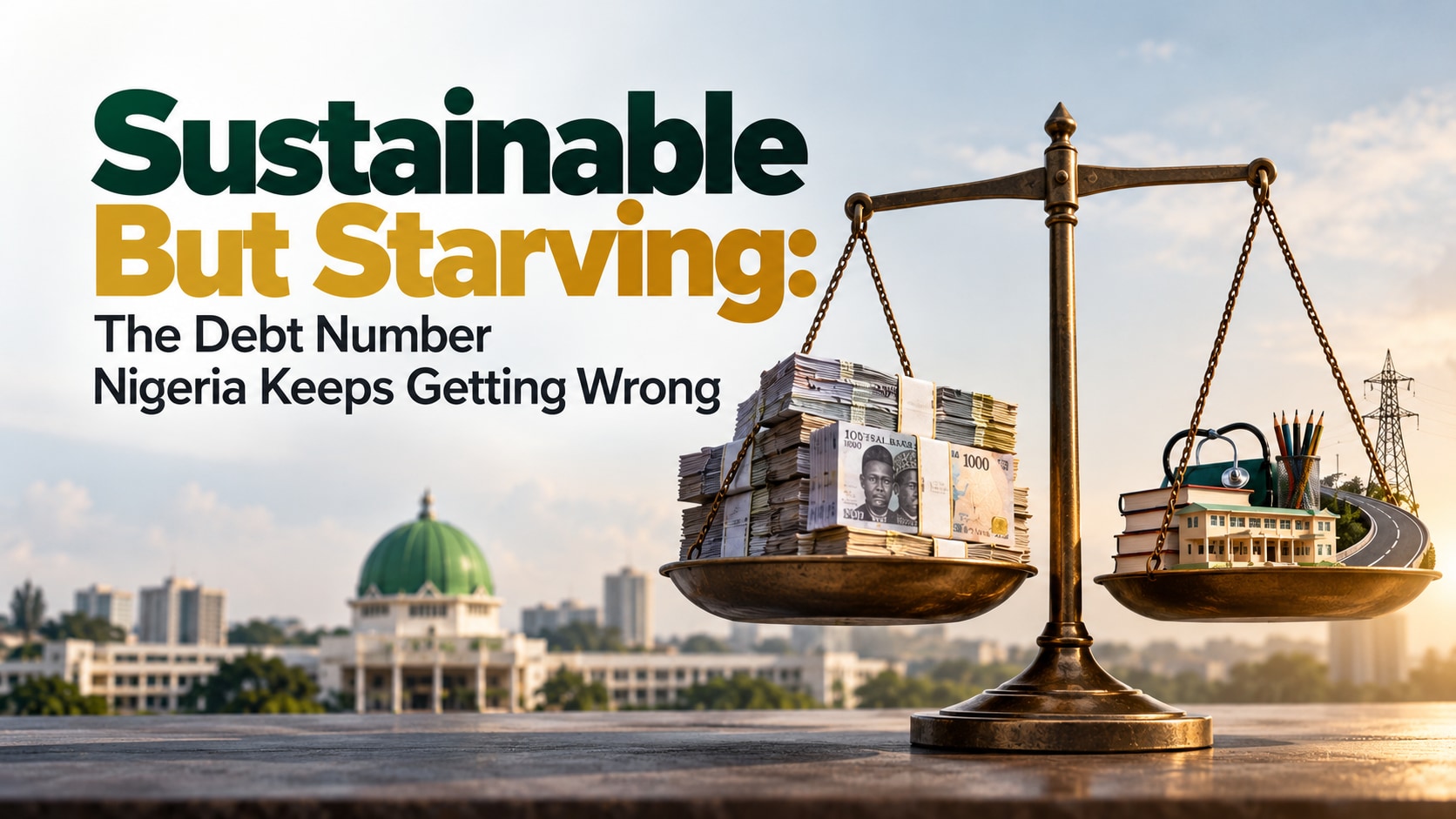
Nigeria's own Finance Ministry has acknowledged that between June 2023 and December 2025, the country incurred ₦10.61 trillion in additional debt-service costs, about ₦4.14 trillion more than the ₦6.47 trillion it spent on strategic infrastructure over the same period.
That is the sustainability paradox made concrete: sustainable enough for a ratings assessment, unaffordable enough to outspend the roads, power, and rail lines the same government names as its own priorities.
Two Honest Levers, Not One Easy Answer
There are only two ways to close this gap, and neither is comfortable.
Government can grow revenue faster than it borrows through tax reform that widens the collection net rather than raising rates on the same taxpayers and by plugging the leakages between what is owed and what is remitted.
Or it can slow the pace of new borrowing until revenue growth catches up, accepting slower spending on the very infrastructure and social programmes debt was meant to fund in the first place.
Nigeria's current trajectory is attempting a version of the first lever without fully committing to the second, which is part of why the interest-to-revenue ratio keeps climbing even as debt-to-GDP falls.
Reform is real. It has not yet outpaced the borrowing.
Why the Confusion Serves No One
None of this is an argument that Nigeria's debt is secretly a crisis dressed up as good news or that the IMF is wrong to call it sustainable.
It is an argument that “sustainable” and “affordable to service without starving everything else” are different tests, and Nigerians deserve to know which one is being cited whenever a debt number appears in a budget defence or a campaign speech.
For a farmer waiting on an agriculture subsidy, a nurse waiting on a hospital budget, or a graduate waiting on a state job, the debt-to-GDP ratio is irrelevant. What matters is the number the government has already committed away before their turn comes, a number now sitting past 53% of everything Abuja collects.
That is the ratio that decides how much is left over.
Until Nigeria's public debt conversation starts leading with that number instead of the friendlier one, most citizens will keep hearing that things are sustainable while feeling, correctly, that they are not.
The Centre for Inclusive Social Development (CISD) is a non-profit research and advocacy organisation working to advance inclusive governance, gender and social equity, civic technology, and sustainable livelihoods across Nigeria and sub-Saharan Africa. Through rigorous research, coalition-building, and public-interest storytelling, CISD amplifies the voices of marginalised communities and holds power accountable.
Learn more at cisdnigeria.org or follow us on social media.
How to cite this article
Tobechukwu Ezeuko. (2026, October 14). Sustainable But Starving: The Debt Number Nigeria Keeps Getting Wrong. CISD Insights. Centre for Inclusive Social Development. Retrieved from https://cisdnigeria.org/article/sustainable-but-starving-the-debt-number-nigeria-keeps-getting-wrong/.