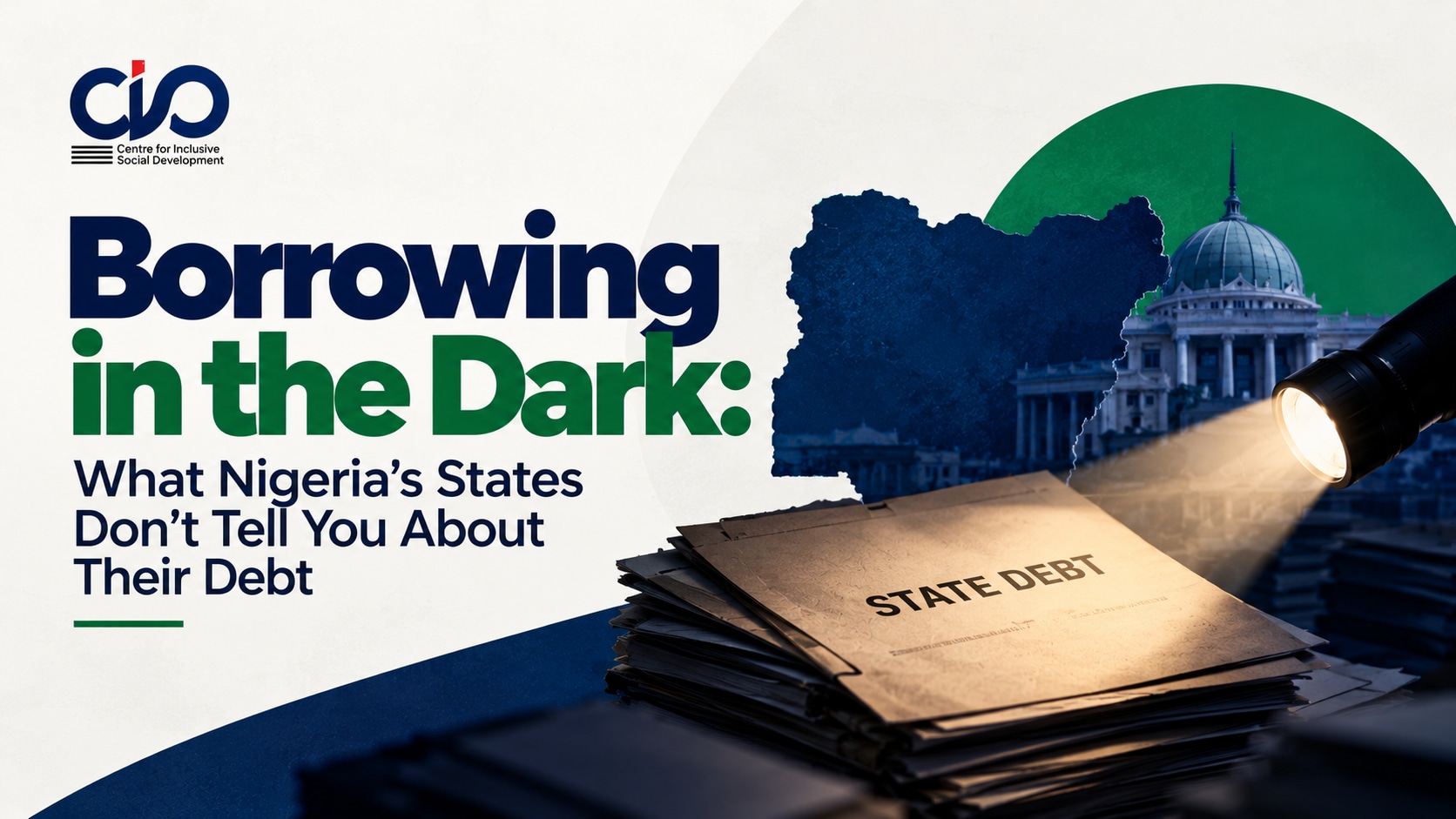
Every quarter, the Debt Management Office publishes a simple table: how much each of Nigeria's 36 states and the Federal Capital Territory owes in domestic debt. As of March 2026, the combined total stood at ₦4.52 trillion, up from ₦4.36 trillion three months earlier. Lagos alone accounted for more than a quarter of it, at ₦1.21 trillion. Lagos, the FCT, and Rivers State together held 43.27% of the entire subnational debt stock. On its face, this looks like a transparency success story: a federal agency, publishing granular, state-by-state figures, every quarter, on schedule. And in one narrow sense, it is. The problem is what the table does not say.
A Number That Moved, and No One Explained Why
Between December 2025 and March 2026, the FCT's domestic debt stock more than doubled, from ₦188.86 billion to ₦389.88 billion, in a single quarter. Borno's did the same, rising from ₦42.64 billion to ₦88.44 billion. Yobe's debt rose by more than a fifth in the same three months. These are not small movements, and they are not explained anywhere in the public record available to an ordinary citizen. The DMO bulletin records that the number changed. It does not say to whom the money is owed, on what terms, at what interest rate, for what project, or why a state's debt load could jump by more than 100% in ninety days. This is the actual gap in Nigeria's subnational debt transparency, and it is a narrower, more precise problem than the common claim that “no data exists". Data exists. It is thin.
Applying the Same Test, One Level Down
There is a useful four-part test for whether financial disclosure is real transparency or just the appearance of it: is the information published at all (availability); published while it can still matter (timeliness); detailed enough to trace a specific transaction (granularity); and checkable by someone outside government (verifiability). Nigeria's federal debt reporting has been assessed against exactly this kind of test before, and it tends to pass the first two and struggle with the last two. States pass the same first two tests, thanks to the DMO's quarterly bulletin. They fail the same last two, for reasons almost nobody examines, because state-level DMO data rarely receives the scrutiny federal figures do.
The Ledger Problem
Picture a household bank statement that records only the closing balance each month — no line items, no payee names, no explanation for a sudden withdrawal. You would know your balance changed. You would have no way to know whether you had been paid correctly, overcharged, or robbed. That is the position Nigerian citizens are in with respect to their own state's borrowing: informed of the total, blind to everything that produced it. A ₦200 billion jump could be a legitimate infrastructure bond issued at a competitive rate for a named capital project. It could just as easily be an emergency overdraft at a punitive rate to cover a revenue shortfall. From the outside, looking only at the DMO's published stock table, there is no way to tell the difference.
Foreign Bondholders Know More Than Local Taxpayers
This produces a genuinely strange inversion. International holders of Nigeria's federal Eurobonds receive prospectuses, credit ratings, and disclosure documents detailing terms, covenants, and use-of-proceeds before they will lend a dollar. A resident of Borno State, whose state government's domestic debt just doubled in three months, has access to none of the equivalent information about the debt being taken on in their name — repayable eventually out of the same federal allocations and internally generated revenue that fund their state's schools and clinics. Foreign creditors, in effect, see more of Nigeria's subnational borrowing than Nigerian citizens do.
The Fix Does Not Require a New Agency
The DMO already has the infrastructure to solve most of this: it collects and publishes the aggregate figures quarterly without apparent difficulty. Extending the same disclosure standard already being discussed for federal loans — lender identity, interest rate, tenor, and stated purpose, down to the state level would not require new legislation so much as an extension of a reporting template the DMO already runs. What is missing is not capacity. It is a requirement.
What This Means at Home
None of this requires assuming any state is hiding something improper. It requires noticing that the current level of disclosure makes it impossible to know either way. A citizen cannot hold a state government accountable for a debt decision they were never shown the terms of, and a doubling of debt in ninety days deserves, at minimum, a public answer to the question the DMO bulletin never asks: what was this money for, and who supplied it?
The Centre for Inclusive Social Development (CISD) is a non-profit research and advocacy organisation working to advance inclusive governance, gender and social equity, civic technology, and sustainable livelihoods across Nigeria and sub-Saharan Africa. Through rigorous research, coalition-building, and public-interest storytelling, CISD amplifies the voices of marginalised communities and holds power accountable.
Learn more at cisdnigeria.org or follow us on social media.
How to cite this article
Tobechukwu Ezeuko. (2026, October 14). Borrowing in the Dark: What Nigeria's States Don't Tell You About Their Debt. CISD Insights. Centre for Inclusive Social Development. Retrieved from https://cisdnigeria.org/article/borrowing-in-the-dark-what-nigerias-states-dont-tell-you-about-their-debt/.