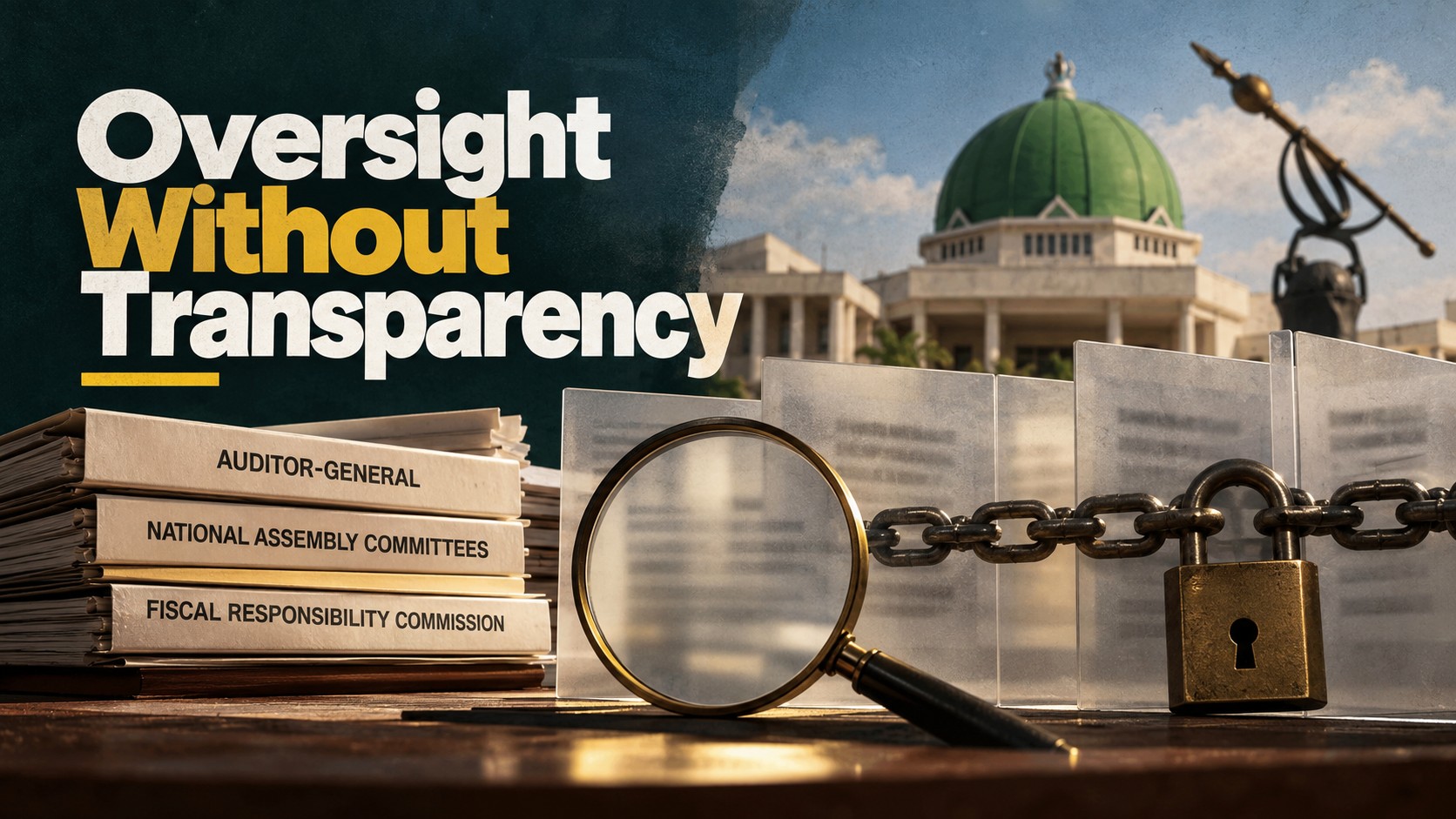
Nigeria has an Auditor-General for the Federation. It has National Assembly committees on Finance, Appropriation, and Public Accounts. It has a Fiscal Responsibility Commission whose entire reason for existing is to police government borrowing.
On paper, the machinery of oversight is there. That is not a small thing.
In the 2023 Open Budget Survey, one of the leading international assessments of budget transparency, public participation and oversight, Nigeria scored 61 out of 100 on oversight, the only one of the survey's three pillars to cross its threshold for “adequate.” The legislature and the audit institution formally have the mandate, and on paper the capacity, to scrutinise how the government borrows and spends.
But the same survey scored Nigeria's budget transparency at just 31 out of 100, and public participation at 19.
Sit those three numbers next to each other and a specific problem comes into focus: Nigeria has built watchdogs, and then quietly starved them of the one thing a watchdog actually needs to do its job: information.
Not because the information doesn't exist, but because it often arrives too late, in too little detail, or in a form nobody outside the government can verify.
A referee who isn't shown the tape
Think of the Auditor-General's office as a referee whose job is to check whether the government followed its own rules on borrowing and spending. A referee can only make a fair call if they can see the play.
Nigeria's audit institution has a constitutional mandate to examine public accounts and report its findings to the National Assembly. The Open Budget Survey also expects an audit report within 18 months of the fiscal year's end, then separately checks whether findings are followed up once they're out.
Formal existence and effective function are two different things, and the gap between them is where Nigeria's oversight advantage quietly evaporates.
The same pattern shows up with the National Assembly. Committees can question ministers, summon officials, and demand records. But a committee cannot scrutinise a loan whose terms it has never seen, or a disbursement that was never disclosed at the transaction level, or a budget line whose execution rate is reported as a single ministry-wide percentage with no project attached to it.
You cannot oversee what was never shown to you.
What good transparency actually requires
It helps to be precise about what “seeing the numbers” means. Financial transparency worth the name has to pass four tests:
Nigeria's oversight problem is rarely a failure on the first test. It is almost always a failure on the other three. That distinction matters, because it points to a different fix than “publish more.”
This isn't theoretical, it's happening right now
Start with the Budget Implementation Report, the single document that lets anyone check how the government actually spent money against what it was approved to spend. Under the Fiscal Responsibility Act, it is due 30 days after each quarter ends.
In 2025, the first two quarterly reports were not published until December, nearly a year late. The third-quarter report fared no better: it briefly appeared on the Budget Office's website in May 2026, was taken down, and was not reuploaded until 24 August 2026, some seven months late. The fourth-quarter report has still not been published at all.
By May 2026, the first-quarter 2026 report was also overdue, and multiple independent outlets reported this as the first time in fifteen years that the Budget Office had failed to publish quarterly reports on schedule for three consecutive quarters.
The government's explanation, that the 2025 Appropriation Act was repealed and re-enacted, extending the implementation window to June 2026, may be procedurally accurate. It does not change the result: for the better part of a year, no committee, journalist, or citizen has had a reliable, timely record of how a ₦68 trillion budget was actually being spent, and part of that record, as of this writing, still doesn't exist.
This is a timeliness failure, not an availability one.
The pattern repeats, worse, at the audit level. As of mid-2026, the most recent Consolidated Financial Statement the National Assembly had finished auditing was for 2022, and the Auditor-General's office had not yet received the underlying statements for 2023, 2024, or 2025, meaning the backlog starts before the audit itself can even begin.
The Auditor-General's report for the 2024 financial year, only transmitted to the National Assembly in July 2026, flagged more than ₦1.34 trillion in infractions across 31 findings: unremitted revenue, unsupported payments, irregular contracts. Three years earlier, the 2021 audit had found ₦3.403 trillion in infractions across 28 agencies.
The two figures should not be read as a trend line: they come from different audit years and different agency coverage, so a lower number does not mean the underlying problem has shrunk. It is also worth being precise that “infractions” here means irregularities in process and record-keeping, not confirmed theft or financial loss.
What the two reports do share is a pattern: the same categories (unremitted revenue, unsupported payments, irregular contracts) recur year after year, and the audit process may still struggle to secure an effective corrective response once they're identified.
The fix for that specific problem already exists on paper. A Federal Audit Service Bill, designed to strengthen the Auditor-General's institutional standing, was passed by the National Assembly and sent to the President for assent. As of this writing, it has sat on his desk for months, well past the thirty days the Constitution allows for a decision either way, neither signed into law nor returned with objections.
Why the 61 doesn't protect you the way it should
Oversight institutions are supposed to be the public's proxy: the people whose job it is to ask the hard questions on our behalf, because most of us don't have the time, access, or technical training to go through a budget line by line ourselves.
When the oversight score is decent but the transparency score is weak, that proxy relationship breaks down quietly. The Auditor-General can exist, the committees can meet, the hearings can happen, and none of it produces accountability, because the underlying numbers were never made available in a form anyone could actually check.
Nigeria's own debt reporting illustrates the four tests precisely. Loan agreements are treated as confidential by default, so a committee reviewing a new loan is often working from a summary, not the contract: a granularity failure.
Disbursements are not tracked at the transaction level, so there is no ledger a committee, a journalist, or a researcher can check line by line: granularity again.
Physical project completion is typically self-reported by the same agency spending the money, with no requirement to say who verified it: a verifiability failure.
The institution meant to provide oversight is technically doing its job. It simply isn't being given anything solid to oversee.
The fix is not more committees, it's more disclosure
The instinct, when oversight looks weak, is often to propose new institutions: another commission, another unit, another layer of scrutiny. Nigeria's numbers argue against that instinct. The oversight architecture already scores reasonably well. What's missing is not another watchdog, it's the leash of actual information connecting the watchdogs to what they're meant to be watching.
Three concrete, achievable changes would do more for real accountability than any new institution.
First, loan agreements should be disclosed as a matter of course (even in redacted or term-sheet form where genuine confidentiality is warranted) so that National Assembly committees and independent auditors are reviewing actual contracted terms, not summaries prepared after the fact. At minimum, that disclosure should cover the lender, principal, currency, interest rate, maturity, repayment schedule, purpose, and disbursement status of every sovereign loan.
Second, disbursements should be tracked and published transaction by transaction, not as a quarterly aggregate, so oversight bodies can trace a specific drawdown (date, amount, lender, project, agency) to a specific use, rather than accepting a lump-sum figure on trust.
Third, the Auditor-General's timeliness should become a measurable, published standard, not an informal expectation. A public dashboard tracking when statements are received, when audits begin and end, when reports reach Parliament, and how many recommendations are implemented would turn a chronic, invisible delay into something trackable, the way election results or exam release dates are tracked.
Audits currently lag their reference year by three to four years, and the Federal Audit Service Bill that could help fix the incentive problem has already cleared the National Assembly. Signing it is the first step; publishing the scorecard is the second.
What this means for advocacy
For civil society, youth organisations, researchers, and the media, the useful question is not simply whether Nigeria has oversight institutions. It clearly does.
The better questions are: What information can those institutions actually see? How quickly do they receive it? Is there enough detail to trace an individual transaction? Can it be independently verified? And what happens when an audit finds a problem?
A Fiscal Responsibility Commission with limited enforcement power, a National Assembly working from a multi-year-old audit, a Budget Implementation Report that took seven months to reappear and still has a missing quarter, and a reform bill sitting unsigned on a desk are not signs of a broken oversight system.
They are signs of a well-designed oversight system that has been quietly cut off from the data it needs to function.
Closing that gap doesn't require reinventing Nigeria's institutions. It requires giving the ones that already exist something real to look at, on the schedule the law already promises.
The Centre for Inclusive Social Development (CISD) is a non-profit research and advocacy organisation working to advance inclusive governance, gender and social equity, civic technology, and sustainable livelihoods across Nigeria and sub-Saharan Africa. Through rigorous research, coalition-building, and public-interest storytelling, CISD amplifies the voices of marginalised communities and holds power accountable.
Learn more at cisdnigeria.org or follow us on social media.
How to cite this article
Rasaq Kareem. (2026, October 14). Oversight Without Transparency: Why Nigeria's Watchdogs Still Can't See the Full Financial Picture. CISD Insights. Centre for Inclusive Social Development. Retrieved from https://cisdnigeria.org/article/oversight-without-transparency/.