Nigeria's external debt payments reveal more than the size of its obligations. They show how much it costs to keep those obligations running, particularly when commercial creditors are involved.
Between January and June 2026, Nigeria paid approximately $1.82 billion in external debt service. But where did the money go?
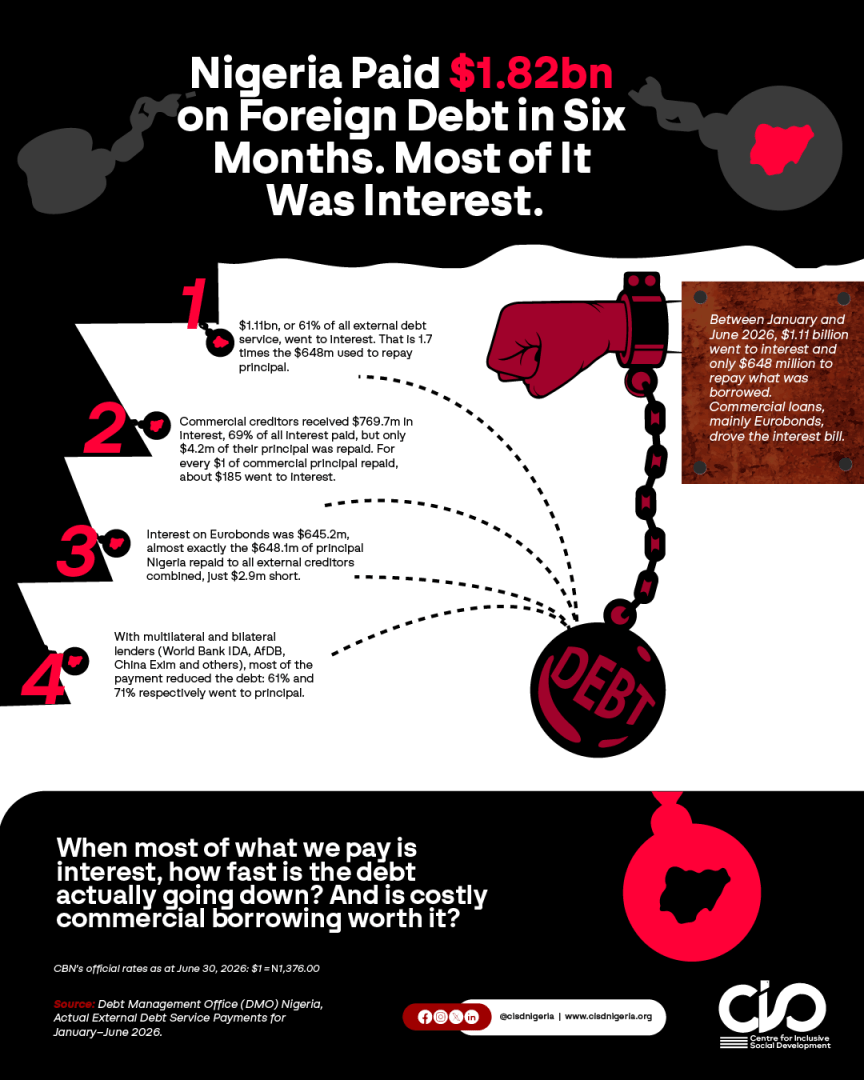
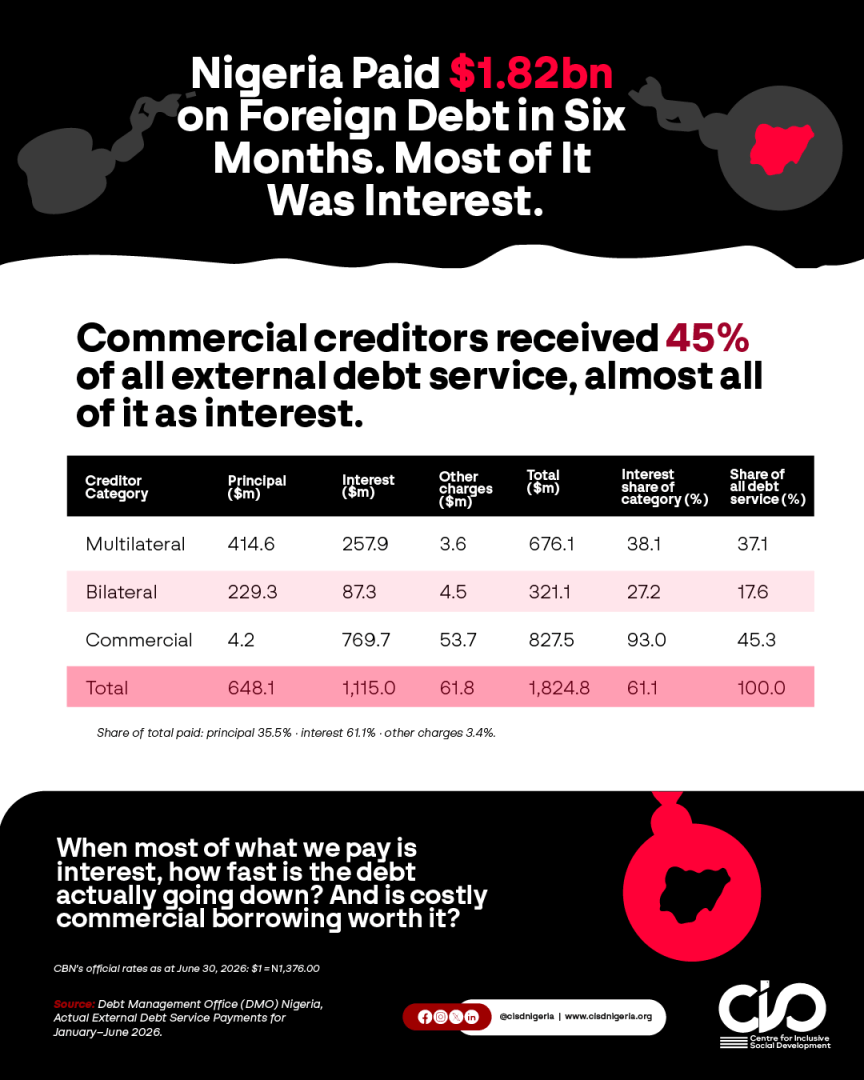
Data from the Debt Management Office (DMO) show that $1.115 billion, representing 61.1% of total payments, went towards interest. Another $648.1 million, or 35.5%, went towards principal repayment. Other charges accounted for the remaining 3.4%.
The breakdown raises important questions about the cost of Nigeria's external borrowing and the implications for its future fiscal commitments.
The commercial borrowing question
Commercial creditors received $827.5 million, accounting for approximately 45.3% of Nigeria's total external debt service during the period.
Of this amount, $769.7 million went towards interest payments. Only $4.2 million went towards principal repayment.
In other words, interest accounted for 93% of payments to commercial creditors.
Eurobond interest payments alone stood at $645.2 million, almost matching the $648.1 million Nigeria repaid in principal across all external creditor categories.
The picture was different for multilateral and bilateral creditors. Their payments included considerably larger principal repayments, with 61% and 71% of their respective payments going towards reducing principal.
Why these figures matter
The composition of debt service matters because borrowing is not only about securing funds. It is also about the terms attached to those funds and the obligations they create over time.
High interest payments can place pressure on public finances, particularly when a substantial share of available resources is committed to servicing existing obligations.
For Nigeria, these figures make a strong case for closer scrutiny of commercial borrowing, loan terms, debt management strategies and the economic value expected from borrowed funds.
The critical question is not simply whether Nigeria can continue to borrow, but whether its borrowing choices are financially sustainable and deliver sufficient value to justify their cost.
Beyond the debt figures
Public debt accountability requires citizens and institutions to look beyond headline debt totals. It requires understanding who lends to the country, what the loans cost, how repayments are structured and what benefits the borrowed funds deliver.
Through its #KnowTheDebt campaign, the Centre for Inclusive Social Development (CISD) continues to promote greater transparency and accountability in Nigeria's public debt management.
The question remains: when so much of what Nigeria pays goes towards interest, are its borrowing choices delivering enough value to the country?
Source: Debt Management Office (DMO) Nigeria, Actual External Debt Service Payments for January–June 2026. Exchange rate reference: CBN official rate as at 30 June 2026, $1 = ₦1,376.
The Centre for Inclusive Social Development (CISD) is a non-profit research and advocacy organisation working to advance inclusive governance, gender and social equity, civic technology, and sustainable livelihoods across Nigeria and sub-Saharan Africa. Through rigorous research, coalition-building, and public-interest storytelling, CISD amplifies the voices of marginalised communities and holds power accountable.
Learn more at cisdnigeria.org or follow us on social media.
How to cite this article
Job Olaniran. (2026, November 10). The Price of Borrowing: Nigeria Paid $1.82 Billion in External Debt Service in Six Months: The breakdown raises important questions about the cost of Nigeria's external borrowing and the implications for its future fiscal commitments.. CISD Insights. Centre for Inclusive Social Development. Retrieved from https://cisdnigeria.org/article/the-price-of-borrowing-nigeria-paid-1-82-billion-in-external-debt-service-in-six-months/.