Nigeria’s debt conversation often begins with one question: How much does the country owe?
But another question deserves equal attention:
What does the cost of servicing that debt mean for the resources available for development?
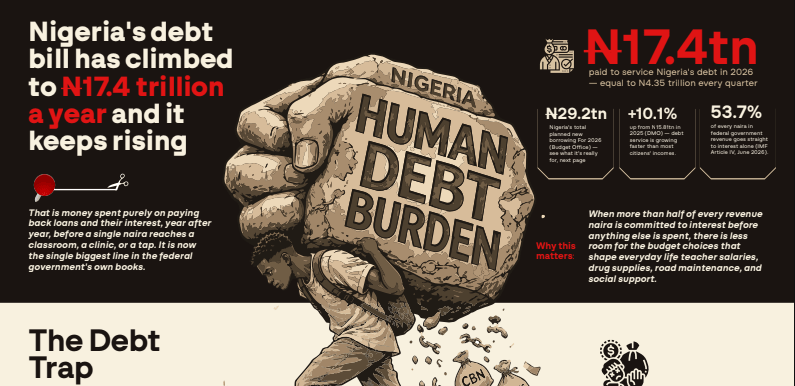
In 2026, Nigeria is projected to spend ₦17.4 trillion servicing its debt, equivalent to ₦4.35 trillion every quarter. At the same time, the country’s planned new borrowing stands at ₦29.2 trillion, with 59.6% of that borrowing committed to servicing existing debt.
This raises a bigger question: how much of new borrowing is actually available to finance new development?
The Debt Trap
Nearly six of every ten naira Nigeria plans to borrow in 2026 will go towards servicing existing debt.
Of the ₦29.2 trillion gross borrowing plan, ₦17.4 trillion is committed to debt service, leaving ₦11.8 trillion for roads, salaries, schools and other spending.
But this is not simply an argument against repaying existing obligations. Debt service is a contractual obligation.
The question is about scale, transparency and opportunity cost: what does recurring debt service mean for the fiscal space available for new development?
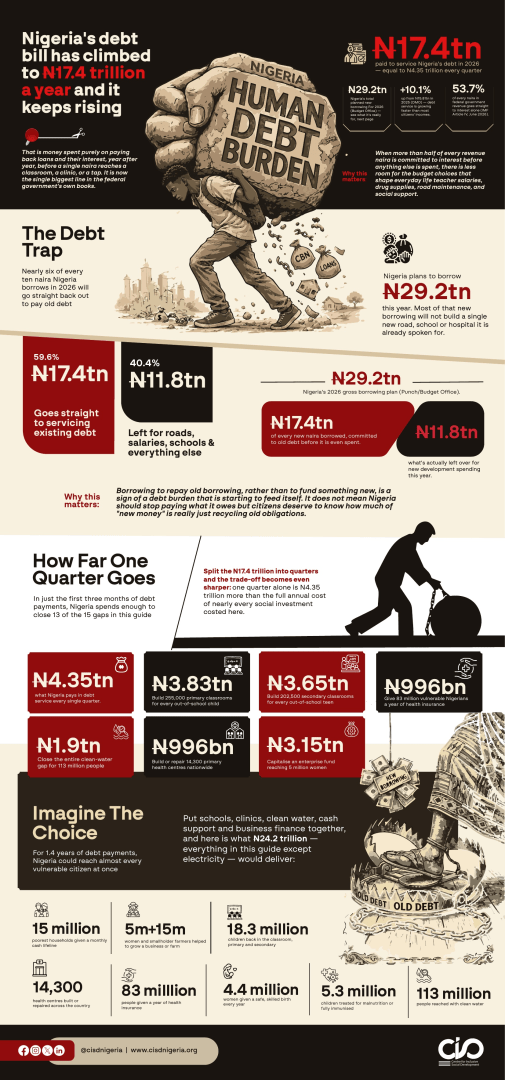
The Debt Trap: Nigeria’s 2026 debt-service burden, borrowing plan and illustrative comparisons with selected development interventions.
What Does One Quarter of Debt Service Represent?
Nigeria’s projected ₦17.4 trillion annual debt-service bill works out to ₦4.35 trillion every quarter. The analysis uses that figure to illustrate the scale of the resources involved by comparing it with selected development interventions.
For example, the analysis estimates:
- ₦3.83 trillion to build 255,000 primary classrooms
- ₦3.65 trillion to build 202,500 secondary classrooms
- ₦996 billion to provide a year of health insurance for 83 million vulnerable Nigerians
- ₦996 billion to build or repair 14,300 primary healthcare centres
- ₦3.15 trillion to capitalise an enterprise fund reaching 5 million women.
These comparisons are intended to make the scale of debt service more tangible.
The Bigger Picture
The analysis then looks beyond a single quarter and examines the estimated cost of addressing development gaps across electricity, education, social protection, health, women's economic inclusion and WASH.
Together, these gaps are presented at an estimated ₦58.7 trillion, equivalent to approximately 3.4 years of Nigeria's current debt service.
The sector breakdown includes:
₦34.5tn — Electricity access
₦8.3tn — Education
₦8.3tn — Cash transfers/social protection
₦6.03tn — Health
₦3.5tn — Women's economic inclusion
₦1.9tn — WASH/clean water
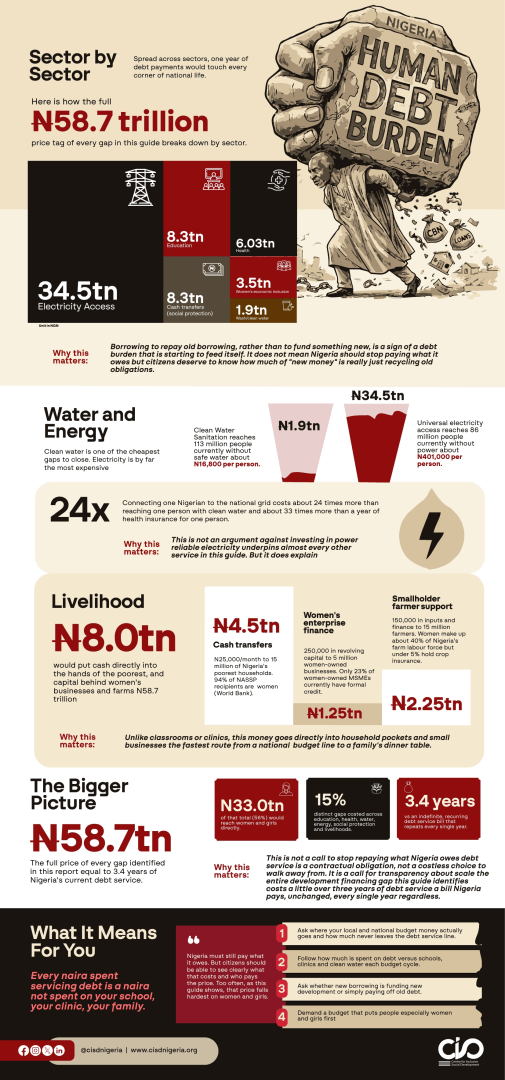
The Debt Trap: the estimated cost of selected development gaps across sectors and what the debt burden means for citizens.
What Does This Mean for Citizens?
The numbers can feel distant when expressed in trillions.
But the issues they represent are not distant.
They are schools, healthcare, clean water, electricity, household income and opportunities for people to build livelihoods.
The analysis therefore ends with four questions:
Where does public budget money actually go?
How much is spent on debt compared with schools, clinics and clean water?
Is new borrowing funding new development or simply paying off old debt?
What should citizens expect from the budgets that affect their lives?
These questions are central to understanding debt not simply as a financial figure, but as a public accountability issue.
Explore the Full Breakdown
The Centre for Inclusive Social Development (CISD) is a non-profit research and advocacy organisation working to advance inclusive governance, gender and social equity, civic technology, and sustainable livelihoods across Nigeria and sub-Saharan Africa. Through rigorous research, coalition-building, and public-interest storytelling, CISD amplifies the voices of marginalised communities and holds power accountable.
Learn more at cisdnigeria.org or follow us on social media.
How to cite this article
CISD. (2026, October 5). The Debt Trap: What ₦17.4 Trillion in Debt Service Could Mean for Nigerians. CISD Insights. Centre for Inclusive Social Development. Retrieved from https://cisdnigeria.org/article/the-debt-trap-what-17-4-trillion-in-debt-service-could-mean-for-nigerians/.