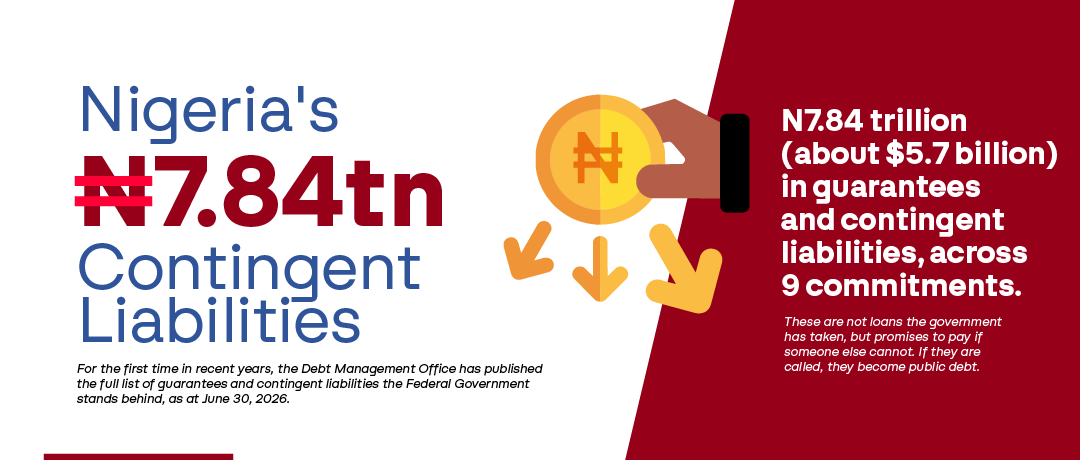
Nigeria's public debt exposure goes beyond the loans government has directly taken. A newly published breakdown of Federal Government guarantees and contingent liabilities reveals ₦7.84 trillion in potential financial obligations across nine commitments.
When we talk about public debt, the conversation usually focuses on how much government has borrowed and how much it must repay. But there is another part of the country's financial exposure that deserves attention: money government may be required to pay if other parties fail to meet their obligations.
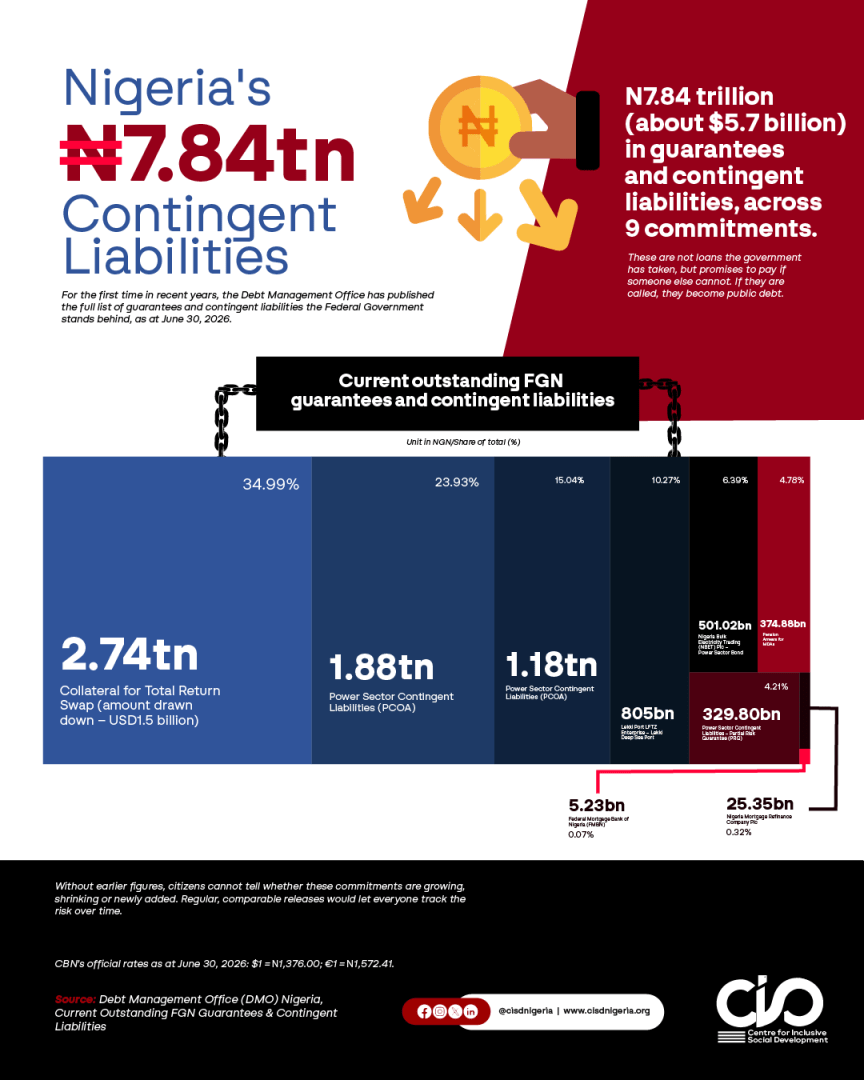
As at 30 June 2026, the Debt Management Office (DMO) reported ₦7.84 trillion in Federal Government guarantees and contingent liabilities across nine commitments.
These are not necessarily loans government has taken or debts it must pay immediately. They are financial commitments made on behalf of other parties. If the parties covered by these guarantees cannot meet their obligations, government may have to step in. If called, these commitments can become public debt.
One arrangement accounts for about 35%
The breakdown reveals a significant concentration of exposure.
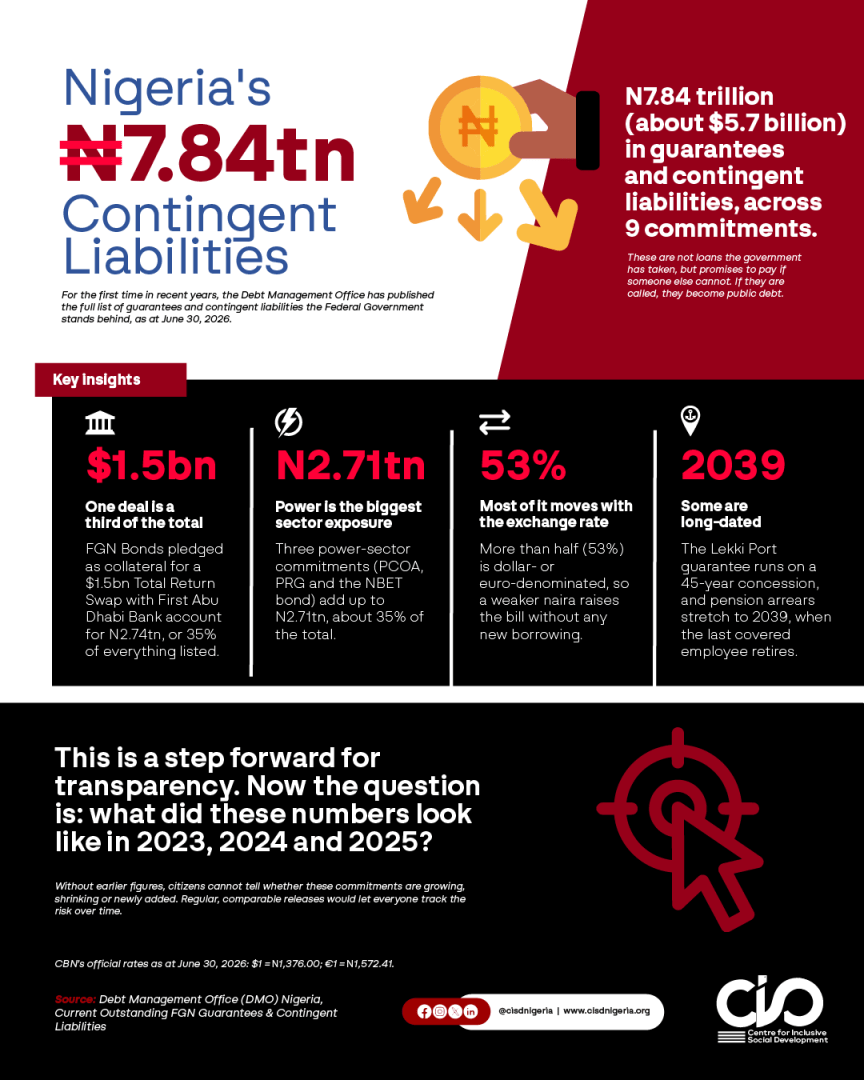
A Total Return Swap arrangement involving First Abu Dhabi Bank accounts for ₦2.74 trillion, approximately 35% of the total reported commitments. The arrangement involved Federal Government bonds pledged as collateral for a $1.5 billion Total Return Swap.
Power sector commitments are another major area of exposure. Three commitments involving the Power Sector Contingent Liabilities and the Nigeria Bulk Electricity Trading (NBET) bond amount to approximately ₦2.71 trillion, representing about 35% of the total.
Other commitments include the Lekki Port guarantee, pension-related obligations and mortgage-related guarantees.
The foreign exchange exposure
Another important finding is the currency composition of these commitments.
Approximately 53% of the reported exposure is denominated in US dollars or euros. This means that changes in the exchange rate can increase the naira value of these obligations even without additional borrowing.
For a country managing significant debt service obligations and competing fiscal priorities, this exposure matters. A weaker naira could make these commitments more expensive if they become payable.
Some commitments extend far into the future
The risks are not limited to immediate financial obligations.
The Lekki Port guarantee is linked to a 45-year concession, while some pension-related obligations extend to 2039, when the last covered employee is expected to retire.
This makes consistent monitoring especially important. Without regular and comparable disclosures, citizens cannot easily determine whether these commitments are increasing, reducing or being replaced by new ones.
Why transparency matters
The publication of the DMO's breakdown is a step forward for public financial transparency. But disclosure is only the beginning.
Citizens, researchers and oversight institutions need to know what these guarantees cover, how they are valued, what conditions could trigger payment and how the risks change over time.
Regular reporting would make it possible to track the commitments, assess their potential impact on public finances and identify emerging risks before they become actual government liabilities.
Nigeria's debt accountability conversation must therefore go beyond what government has borrowed. It must also examine what government has promised to pay.**
Through its #KnowTheDebt campaign, the Centre for Inclusive Social Development (CISD) continues to promote greater transparency in public borrowing and debt management, helping citizens understand the full picture of Nigeria's fiscal obligations.
Source: Debt Management Office (DMO) Nigeria, Current Outstanding FGN Guarantees and Contingent Liabilities as at 30 June 2026. Exchange rates referenced: CBN official rates as at 30 June 2026, $1 = ₦1,376.00; €1 = ₦1,572.41.
The Centre for Inclusive Social Development (CISD) is a non-profit research and advocacy organisation working to advance inclusive governance, gender and social equity, civic technology, and sustainable livelihoods across Nigeria and sub-Saharan Africa. Through rigorous research, coalition-building, and public-interest storytelling, CISD amplifies the voices of marginalised communities and holds power accountable.
Learn more at cisdnigeria.org or follow us on social media.
How to cite this article
Job Olaniran. (2026, November 10). Nigeria's ₦7.84 Trillion Hidden Debt Risk: The Guarantees That Could Become Public Debt. CISD Insights. Centre for Inclusive Social Development. Retrieved from https://cisdnigeria.org/article/nigerias-7-84-trillion-hidden-debt-risk-the-guarantees-that-could-become-public-debt/.