Nigeria's fiscal structure presents a worrying pattern that extends beyond conventional debt metrics. Borrowing for recurrent expenditure: including personnel costs, administrative overheads, and debt servicing obligations, has emerged as one of the most significant fiscal sustainability challenges facing the country. In fiscal policy terms, this reflects a consumption-driven debt structure in which public borrowing is increasingly used to finance the routine operations of government rather than productive investments capable of generating long-term economic returns.
This pattern undermines fiscal sustainability because debt accumulation is not matched by the creation of sufficient revenue-generating assets or productive infrastructure that could support future repayment capacity. The trend also raises important legal concerns under the Fiscal Responsibility Act (FRA) 2007, particularly Section 41(1)(a), which restricts government borrowing primarily to capital expenditure and human development purposes. Where a substantial proportion of public borrowing is used to finance recurrent obligations, government fiscal operations remain in persistent conflict with both the spirit and the express provisions of the Fiscal Responsibility Act’s borrowing framework.
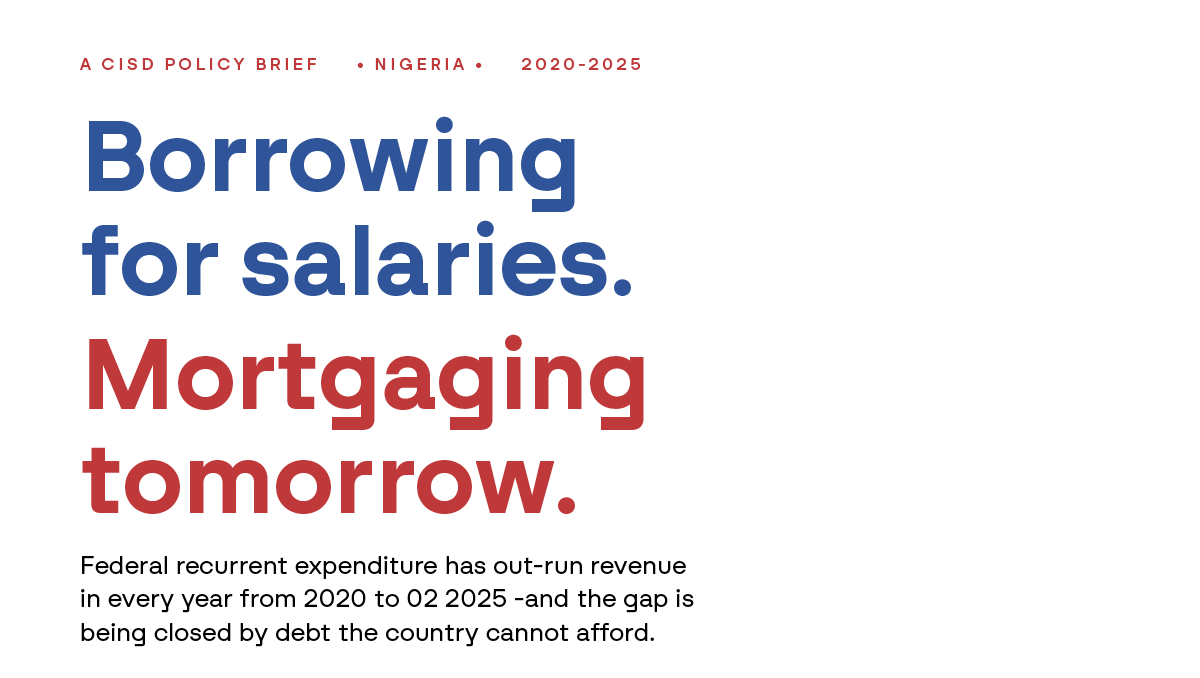
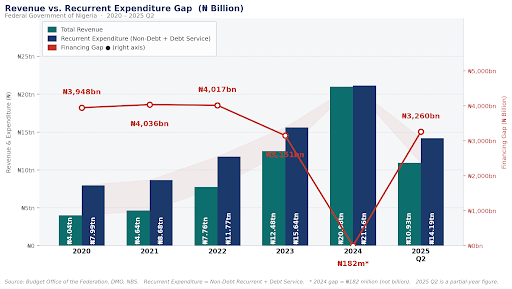
The clearest evidence of this pattern lies in the persistent gap between federally collected revenue and recurrent expenditure obligations. Where total government revenue is insufficient to cover recurrent spending, the implication is that borrowing is indirectly financing the operational costs of the state. Under such circumstances, debt becomes necessary not only for capital projects but also for sustaining salaries, overheads, statutory transfers, and debt servicing commitments. This creates a structural fiscal imbalance in which borrowing substitutes for inadequate revenue generation and weak expenditure discipline.
The fiscal data demonstrates a consistent pattern in which recurrent expenditure significantly exceeds total revenue across successive years. In 2020, the Federal Government generated ₦4.04 trillion in revenue while recurrent expenditure stood at ₦7.99 trillion, creating a financing gap of approximately ₦3.95 trillion. Similar deficits persisted throughout 2021, 2022, 2023, and into 2025 Q2, indicating a sustained structural dependence on borrowing to finance government operations. Although the 2024 budget implementation report suggests a narrowing of the recurrent gap, recurrent obligations still exceed projected revenues by approximately ₦182 million. This trend strongly indicates that a substantial portion of Nigeria's borrowing is being used, directly or indirectly, to support recurrent expenditure rather than purely capital investment as envisaged under the FRA 2007.
The Centre for Inclusive Social Development (CISD) is a non-profit research and advocacy organisation working to advance inclusive governance, gender and social equity, civic technology, and sustainable livelihoods across Nigeria and sub-Saharan Africa. Through rigorous research, coalition-building, and public-interest storytelling, CISD amplifies the voices of marginalised communities and holds power accountable.
Learn more at cisdnigeria.org or follow us on social media.
How to cite this article
Job Olaniran. (2026, May 21). Borrowing for recurrent expenditure: Nigeria's structural fiscal imbalance deepens. CISD Insights. Centre for Inclusive Social Development. Retrieved from https://cisdnigeria.org/article/borrowing-for-recurrent-expenditure-nigerias-structural-fiscal-imbalance-deepens/.