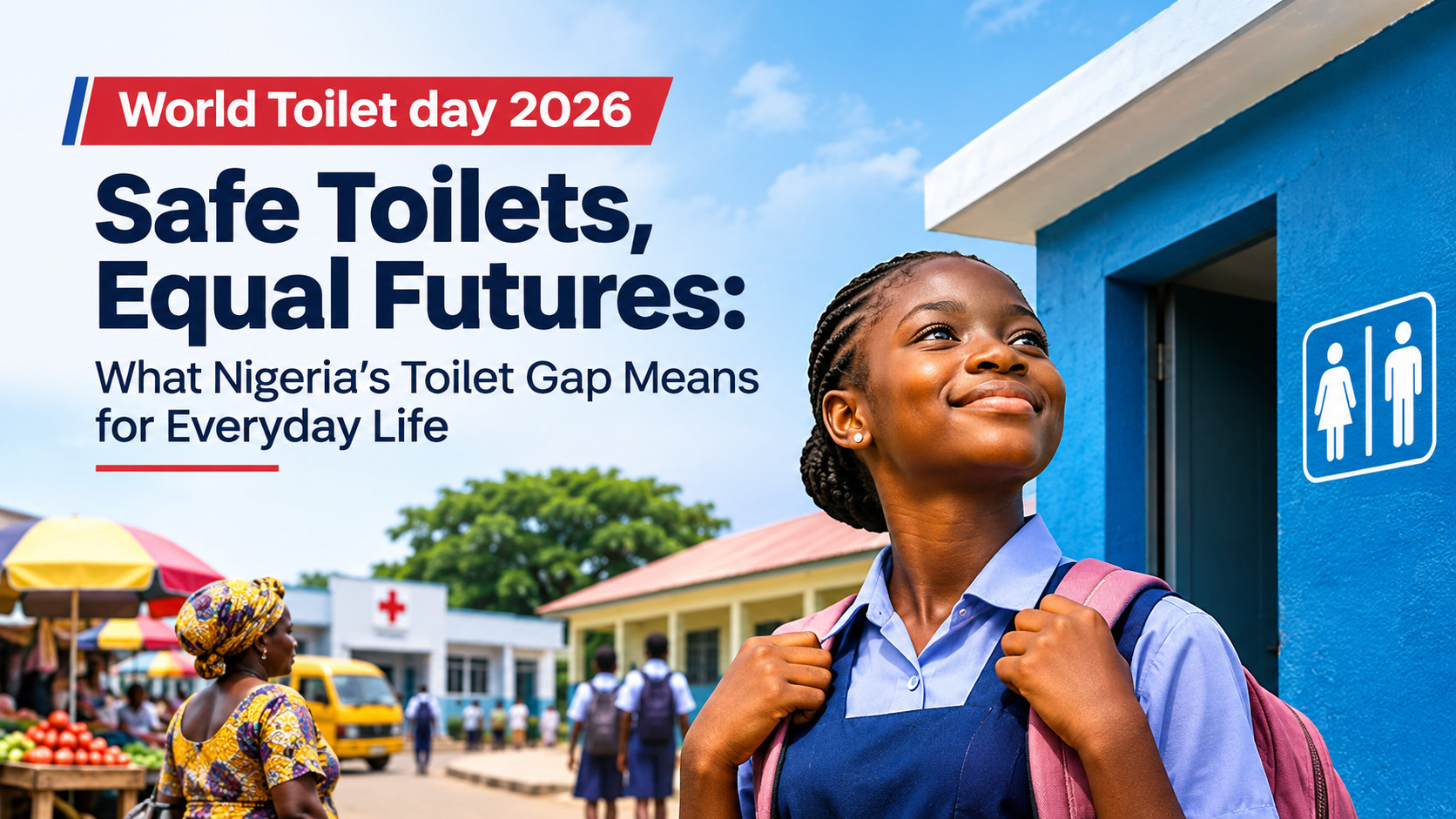
Think about the places you visit every day: your home, a busy market, a motor park, a local school or a neighbourhood clinic. Having access to a clean, private toilet in these places may seem ordinary. Yet, across Nigeria, millions of people still have to plan their daily routines around where and when they can safely use a toilet.
Every year on November 19, World Toilet Day draws attention to this often-overlooked part of everyday life. The 2026 global theme, “Sanitation and Gender Equality,” carries the message: “Safe toilets. Equal futures.” The figures from Nigeria show why this matters. The absence of a toilet is more than an inconvenience. It affects the safety and dignity of women and girls, children's ability to attend school regularly, and the health of families and communities.
A Daily Struggle for Safety and Privacy
According to the 2024 Nigeria Demographic and Health Survey (NDHS), 49% of Nigeria's household population has access to basic sanitation services, compared with 46% recorded in the 2021 WASHNORM survey. However, 20% of Nigerians, or an estimated 45 to 48 million people, still have no toilet and practise open defecation. The gap is particularly wide between rural and urban communities. Only 38% of rural households have access to basic sanitation, compared with 63% of urban households.
For women and girls, the absence of toilets at home, in markets and at motor parks can turn a basic daily need into a safety concern. Some are forced to wait until early morning or late at night before seeking privacy in bushes or isolated areas. These situations expose them to harassment, physical danger and embarrassment, while denying them the privacy and dignity that shouldn’t be taken for granted.
Why Toilets in Schools and Healthcare Facilities Matter
The lack of adequate sanitation also affects children's education, particularly for girls. According to 2026 sector estimates from Save the Children and the Wellbeing Foundation Africa, more than 10 million school children in Nigeria lack access to basic sanitation facilities at school. Meanwhile, benchmarks from the WHO/UNICEF Joint Monitoring Programme (JMP) show that fewer than one in five schools have basic handwashing facilities with soap and water. When schools do not have clean, separate toilets for boys and girls, alongside reliable access to water, girls can face additional difficulties during menstruation. Some miss school because they cannot manage their periods comfortably and privately. Repeated absences can affect their learning, make it harder to keep up with lessons and increase the risk of dropping out.
The situation is also concerning in healthcare facilities. UNICEF data shows that only 6% of Nigerian clinics and hospitals meet basic water, sanitation and hygiene (WASH) standards. Without safe toilets, clean water and adequate hygiene facilities, mothers, newborns and other patients face greater exposure to preventable infections. The situation is particularly urgent in Northeast Nigeria. According to the Nigeria 2025 Humanitarian Needs and Response Plan, conflict and seasonal flooding have left 5.2 million people across Borno, Adamawa and Yobe states in urgent need of basic water and sanitation services.
The Hidden Cost to Families and the Economy
Poor sanitation has consequences beyond health and personal dignity. It also places a financial burden on households and the wider economy. A study by the World Bank Water and Sanitation Program (WSP) estimates that poor sanitation costs Nigeria approximately ₦455 billion (US$3 billion) annually, equivalent to 1.3% of the country's economy. These losses include healthcare expenses, time lost from work and school, and an estimated 87,000 preventable deaths each year among children under five from diarrhoea and other waterborne illnesses.
Closing the sanitation gap will require substantial investment. National sector estimates suggest that Nigeria needs approximately 11.6 million additional toilets across homes, schools, markets and motor parks. Providing these facilities is expected to require about ₦959 billion in public and private investment. These figures point to an important reality: investing in toilets and sanitation is not simply about building facilities. It is also about reducing preventable illness, protecting household incomes, supporting education and making public spaces safer for everyone.
Where Does Nigeria Stand Today?
Nigeria initially set a target of ending open defecation nationwide by 2025. However, the country did not meet that deadline, and the target has been moved to 2030 through a new national executive order and the revised 2025–2030 Clean Nigeria Campaign Strategy, coordinated by the Federal Ministry of Water Resources and Sanitation.
Figures released in November 2026 show some progress, but also the scale of the work that remains:
- 185 of Nigeria's 774 Local Government Areas (LGAs), representing about 24% of all LGAs, have been certified Open Defecation Free (ODF). This means 589 LGAs are yet to receive the certification.
- Jigawa and Katsina are currently the only states where every local government area has been certified Open Defecation Free. All 27 LGAs in Jigawa and all 34 LGAs in Katsina have achieved this status.
Reaching the remaining 589 LGAs by 2030 will require consistent funding from state governments and private sector partners. It will also require regular monitoring to ensure that communities do not return to open defecation. Beyond rural communities, attention must extend to public places where people gather every day. Markets, motor parks, schools and healthcare facilities need functional and properly maintained toilets. Rules requiring these facilities must also be enforced.
Safe Toilets Are About More Than Sanitation
The absence of a toilet affects more than where someone can relieve themselves. It can determine whether a girl attends school, whether a woman feels safe in a public space, whether a patient receives care in a hygienic environment and whether a family is exposed to preventable illness.
As Nigeria works towards its 2030 open defecation target, progress should be measured not only by the number of communities certified Open Defecation Free, but also by whether people can find and use clean, safe and functional toilets where they live, learn, work and receive healthcare. Safe toilets are essential to health, dignity and equal opportunities. No one should have to risk their safety or miss out on education and other opportunities because a basic sanitation facility is unavailable.
Sources Used
- National Population Commission (NPC) & ICF (2025): Nigeria Demographic and Health Survey (NDHS) 2024: Final Report [FR395] & Summary Report [SR294] (Chapter 16).
- WHO and UNICEF Joint Monitoring Programme (August and September 2026): Progress on Water, Sanitation, Hygiene, Environmental Cleaning and Waste Management in Health Care Facilities (2015 to 2025) and Progress on Drinking Water, Sanitation and Hygiene in Schools (2026 Update).
- Federal Ministry of Water Resources & Sanitation (2024 to 2026): Revised Clean Nigeria: Use the Toilet Campaign Implementation Strategy (2025 to 2030) & November 2026 Official Briefing.
- World Bank Water and Sanitation Program (WSP): Economic Impacts of Poor Sanitation in Africa: Nigeria.
- UN OCHA and Nigeria WASH Sector (2025): Nigeria 2025 Humanitarian Needs and Response Plan.
The Centre for Inclusive Social Development (CISD) is a non-profit research and advocacy organisation working to advance inclusive governance, gender and social equity, civic technology, and sustainable livelihoods across Nigeria and sub-Saharan Africa. Through rigorous research, coalition-building, and public-interest storytelling, CISD amplifies the voices of marginalised communities and holds power accountable.
Learn more at cisdnigeria.org or follow us on social media.
How to cite this article
Bola Olowonisi. (2026, November 19). Safe Toilets, Equal Futures: What Nigeria’s Toilet Gap Means for Everyday Life: The absence of a toilet affects more than where someone can relieve themselves. It can determine whether a girl attends school, whether a woman feels safe in a public space, whether a patient receives. CISD Insights. Centre for Inclusive Social Development. Retrieved from https://cisdnigeria.org/article/safe-toilets-equal-futures-what-nigerias-toilet-gap-means-for-everyday-life/.