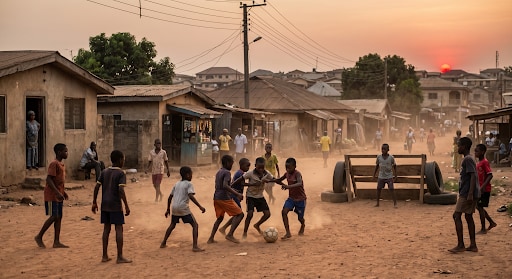
Nigeria is currently facing a "Play Deficit"—a systematic collapse of recreational culture that has profound implications for the nation’s social fabric, economic potential, and public health. Once a cornerstone of daily life across all economic classes, recreation has transitioned from a spontaneous public good to a disappearing "commons." This decline has triggered three compounding crises:
- The Social Cohesion Crisis: The erosion of shared spaces where Nigerians of different tribes, religions, and classes once interacted organically, leading to increased tribalization and social fragmentation.
- The Talent Pipeline Crisis: The destruction of the informal, "deliberate play" environments (streets, schoolyards, open fields) that historically served as the primary incubator for world-class athletic talent.
- The Psychosocial Crisis: A mental health emergency characterized by the loss of natural stress-regulation mechanisms and the stunting of creative cognition in children and youth.
Reversing this deficit requires a fundamental policy shift: reframing recreation not as a peripheral luxury, but as a critical public health intervention and a vital component of human capital development.
The Transition from Play to Deficit
Recreational activity in Nigeria was historically embedded in the daily rhythm of life. It was spontaneous, intergenerational, and accessible regardless of wealth. However, this "informal civic institution" has been dismantled by several factors:
- Urbanization and Fencing: Traditional street play areas have been fenced off, tarred over, or consumed by commercial interests.
- Fiscal Neglect: Local governments, the traditional providers of community pitches and parks, have seen their finances diverted to recurrent expenditure.
- Institutional Collapse: Schools have stripped sports allocations to prioritize examination performance or due to decaying infrastructure.
The result is a "Play Deficit" where unstructured play—the laboratory for learning emotional regulation and social problem-solving—is increasingly unavailable to the majority of the population.
The Three Pillars of the Crisis
Pillar I: The Social Cohesion Crisis
Recreation serves as a "social technology" for integration. Shared play forces participants to submit to common rules, negotiate disputes, and recognize the humanity of others across ethnic or religious divides.
- The Tribalization of Sport: In the absence of shared recreational experiences, national sports like football are becoming viewed through ethnic and regional prisms. When national teams underperform, the discourse on social media frequently devolves into tribal coding, reflecting a broader loss of national unity.
- Infrastructure Deficit: The systematic defunding of parks, community halls, and school pitches has removed the physical stages for shared civic life.
Pillar II: The Talent Pipeline Crisis
While corruption in sports federations is often blamed for Nigeria's inconsistent athletic performance, the root cause is the destruction of the "upstream" talent ecosystem.
- Elite Talent Formation: Sports science indicates that elite athletes emerge from thousands of hours of informal, self-motivated play ("deliberate play") before entering formal academies.
- The School Sports Collapse: The elimination of PE teaching and inter-school competitions has broken the institutional pathway for talent identification.
- Narrowing Focus: Nigeria’s sporting ambitions have catastrophically narrowed toward football, causing disciplines like cricket, athletics, hockey, and table tennis to fade into niche existences.
Pillar III: The Psychosocial Dimension
This is the most pervasive but least visible aspect of the Play Deficit. Play is constitutive of healthy psychological development and serves as a physiological buffer against stress.
- Stress Regulation: Vigorous activity reduces cortisol and stimulates endorphins. In a high-stress society like Nigeria—marked by economic precarity and insecurity—the loss of recreation removes a primary buffer against chronic physiological stress.
- The Creativity Dividend: Unstructured play develops "flexible, creative thinking" and adaptive problem-solving. By removing play, the society is inadvertently stunting the cognitive rehearsals necessary for entrepreneurship and innovation.
- Digital Substitution: Passive digital consumption (scrolling/streaming) does not replicate the benefits of physical play. Research links high passive screen time to increased anxiety, depression, and reduced attention spans among youth.
The Political Economy of Neglect
The Play Deficit is the result of deliberate political choices. Recreational expenditure is consistently sacrificed for more "legible" spending like security or debt service. Furthermore, a class divide has emerged: policy elites access private academies and clubs, insulating them from the collapse of public infrastructure and reducing the political urgency to address the needs of the majority.
Policy Recommendations: A 10-Point Framework
The Centre for International Sport and Development (CISD) proposes the following framework to reverse the Play Deficit:
- Constitutionalize Play: Amend the Fundamental Objectives and Directive Principles of State Policy to recognize access to recreation as a social right.
- National Recreation Investment Fund: Establish a dedicated fund for LGA-level facilities, targeting one public space per 10,000 citizens by 2030.
- School Sports Mandate: Restore Physical Education to the national curriculum with a minimum of five hours of activity per week.
- State Sports Academies: Rehabilitate academies with a 60% intake quota for children from community (non-private) channels.
- Multi-Sport Diversification: Develop a National Multi-Sport Development Plan covering 12 disciplines beyond football.
- Mental Health Integration: Classify recreational investment as a public health expenditure in state and national budgets.
- Local Government Reform: Condition a portion of FAAC allocations on the maintenance of public recreational infrastructure.
- Public-Private Partnerships (PPP): Create tax incentives for corporate investment in community-facing recreational spaces.
- Urban Planning Protections: Formally gazette street and neighborhood play zones to protect land from commercial encroachment.
- Civic Education: Use organized inter-school sports as a vehicle for teaching national unity and constitutional values.
The Play Deficit is a policy-reversible problem. Recreation is not a luxury to be earned after a nation develops; it is a fundamental component of development itself. A nation that cannot play together will struggle to remain a nation that can hold together. The physical and psychological resilience of the next generation depends on the political will to restore the "commons" of play.
READ THE FULL BRIEF HERE:
The Centre for Inclusive Social Development (CISD) is a non-profit research and advocacy organisation working to advance inclusive governance, gender and social equity, civic technology, and sustainable livelihoods across Nigeria and sub-Saharan Africa. Through rigorous research, coalition-building, and public-interest storytelling, CISD amplifies the voices of marginalised communities and holds power accountable.
Learn more at cisdnigeria.org or follow us on social media.
How to cite this article
Folahan Johnson. (2026, May 15). The Play Deficit: How Nigeria Lost Its Recreational Soul: Nigeria’s Play Deficit: A Crisis of Social Cohesion, Talent Development, and Psychosocial Well-being. CISD Insights. Centre for Inclusive Social Development. Retrieved from https://cisdnigeria.org/article/the-play-deficit-how-nigeria-lost-its-recreational-soul/.