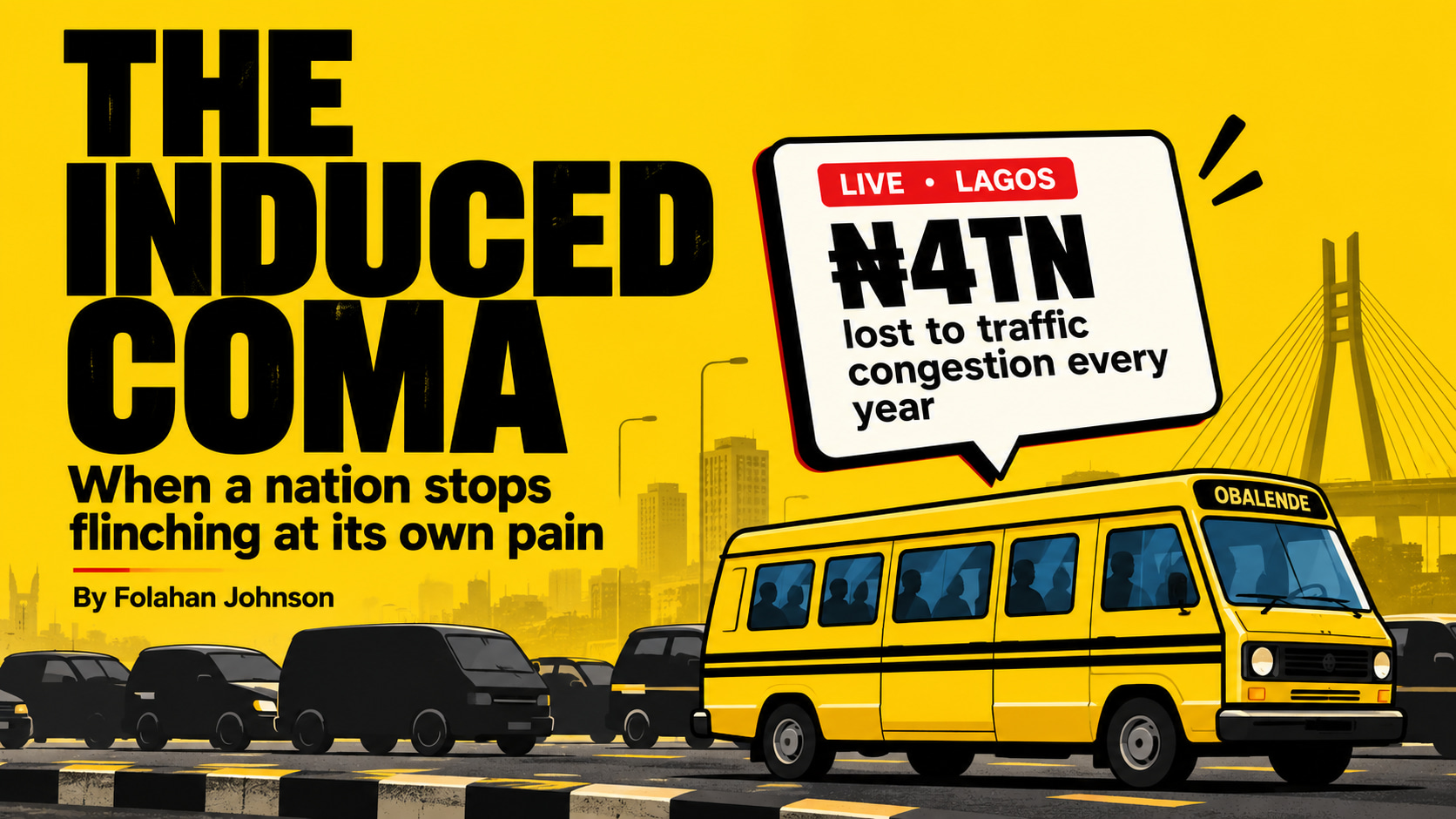
In medicine, an induced coma is a deliberate choice to keep the body still, so it stops reacting to pain. Clinically, it is defined as a temporary, deep state of unconsciousness created by doctors using controlled doses of anaesthetic or sedative drugs to let the brain rest and heal. The patient is alive, but the patient does not flinch.
Sometimes, when you see what has become of us as a people and our attitude to civic issues, I wonder whether that is what has happened to us. Almost every known tragedy has lost its shock value to Nigerians, more like the proverbial, what is it that is coming from yonder that eyes have not seen? A pothole big and deep enough to send a car to an emergency 2-day repair at the mechanic, or a bridge full of commuters stuck for four hours. A budget line that could have fixed the issue never gets funding and is replaced by a convenient line item that suits the governor's or his party's political agenda; it could be a killing in a village we can't easily find on a map. Whatever it, is, thanks to our collective short attention span, most of these get a day on our timelines, and then fade. We share, we sigh, we scroll. By the next day and maximum 36 hours, we have moved on to the next amusing issue on the trend table and, not because anything was fixed, but because we have learned that nothing will be.
Last weekend gave us a small, telling example. Lagos's deputy governor, the man most likely to be its next governor, told an audience that “Lagos traffic is not a problem; it's just a lifestyle.”
His defenders will say it was a joke, a nod to podcasters whose work people consume in traffic. Perhaps. But a joke tells you what the speaker takes for granted. And what this one assumes is that the gridlock is weather: something to endure and even romanticise, not something to govern. Of course, the conversation became a trending issue and the founder of Paga, Tayo Oviosu, was one of the first to react to the issue, and as expected the Deputy Governor reacted to the issue, saying he was deliberately misunderstood, he read Tayo’s psot verbatim and in doing so he showed that he did not know who Tayo was and he probably thinks he is just a political jobber sent by the opposition, The deputy governor of the largest economy in the country does not know the founder of one of the most consequential fintech to emerge out of Africa right out of Lagos in the past 10 years, that is a sad story for another day.
Traffic in Lagos is not a lifestyle. It is an outcome of poor city planning and, by extension, a failure of several interconnected policy designs. It is a direct consequence of decisions about road networks, public transport, land use we can talk about the delicate balance between real estate design and the impact on city planning effectiveness), drainage, and enforcement, and from decisions that were never made. And it has a price. The Danne Institute for Research, working with Financial Derivatives Company, estimated that congestion costs Lagos about ₦3.8 trillion a year. The institute's later survey found that the average resident spends more than two hours a day commuting, and nearly half spend longer. In June 2025, the deputy governor's own government put the loss at ₦4 trillion a year. That is the mother who leaves home before dawn and returns after her children are asleep. It is the trader whose goods spoil on the road. It is the small business bleeding productivity every week. To call this a lifestyle is to turn a ₦4 trillion failure of management into a feature of identity. Once suffering becomes identity, nobody is accountable for it.
That is how the coma works. One statement doesn't induce it. It is induced by a thousand small normalisations: “That's Nigeria.” “Na so e be.” “At least we're alive.” Each one is a sedative. Each one lowers what we expect from those we pay to govern us. Our leaders do not need to fix what we have stopped demanding they fix.
The hard truth is that the sedation is partly self-administered. Numbness has become a survival mechanism people resort to when outrage never produces change; people protect themselves by ceasing to feel. That is understandable. But a citizenry that no longer flinches is one that can be governed badly forever.
So the question is not whether we are tired. We are. The question is whether we will let tiredness become consent.
Waking up does not require a revolution. It requires memory: remembering what was said, and by whom, when they come asking for votes in 2027. It requires asking candidates a simple question. Not “Do you love Lagos?” but “What is your plan for the roads, the rail, and the buses, and when can we hold you to it?”
A coma is supposed to be temporary. The danger is not that we were sedated. The danger is that we grow comfortable enough never to wake.
Sources
Danne Institute for Research, “Economic Costs of Traffic Congestion in Lagos” (with Financial Derivatives Company). https://danneinstitute.org/publications/always-go-with-a-smile-4/
Vanguard, “Lagos loses N4trn annually to traffic congestion” (Danne Institute report, Nov 2023). https://www.vanguardngr.com/2023/11/lagos-loses-n4trn-annually-to-traffic-congestion/
Nairametrics, “Lagos Govt says residents lose N4 trillion annually to traffic congestion” (Jun 2025). https://nairametrics.com/2025/06/13/lagos-govt-says-residents-lose-n4-trillion-annually-to-traffic-congestion/
Vanguard, “'Lagos traffic not a problem; it's a lifestyle' – Hamzat” (Sep 2026). https://www.vanguardngr.com/2026/09/lagos-traffic-not-a-problem-its-a-lifestyle-hamzat/
The Centre for Inclusive Social Development (CISD) is a non-profit research and advocacy organisation working to advance inclusive governance, gender and social equity, civic technology, and sustainable livelihoods across Nigeria and sub-Saharan Africa. Through rigorous research, coalition-building, and public-interest storytelling, CISD amplifies the voices of marginalised communities and holds power accountable.
Learn more at cisdnigeria.org or follow us on social media.
How to cite this article
Folahan Johnson. (2026, October 1). The Induced Coma: When a nation stops flinching at its own pain. CISD Insights. Centre for Inclusive Social Development. Retrieved from https://cisdnigeria.org/article/the-induced-coma/.