She sat on the roadside, her head bowed, her eyes heavy with fatigue, and a bucket of drinks was placed before her. On her back was a baby, barely two years old, watching quietly, bound to a life she did not choose. That child should have been in a daycare, learning her first words, drawing her first lines, playing with her peers. Instead, she was strapped to her mother's back under the sun, waiting for a stranger to stop and buy a bottle of water.
The mother's mind, no doubt, was full. How does she feed this child? How does she pay rent, buy food, and cover school fees? Her face asked questions no one seemed to be answering. But help came that day, not from a government program, not from a social safety net, but from a private citizen: a content creator, MrBike_Global, who bought out her goods and shared with onlookers and gave her cash, an amount she probably hasn't received in a long time. She dropped to her knees in tears. Those watching stood silently, some moved, others were stunned. The moment went viral, but the struggle it captured is painfully unforgettable.
This is the reality for millions of Nigerians today, who grapple with poverty and find it difficult to feed or care for loved ones. At this point, we begin to ponder, where is the government's empathy?
Nigeria's Economic Burden
Nigeria, home to over 210 million people, continues to grapple with deep-rooted poverty. According to the National Bureau of Statistics, over 40% of the population lives in extreme poverty. Inflation continues to spiral. The prices of food, transport, rent, clothing, and healthcare continue to balloon. On the other hand, the official employment rate stands at 76.1%. The Nigerian Consumer Outlook Report (2025) by SEID reveals a stark truth: nearly 40% of employed Nigerians earn less than ₦100,000 monthly, while one in three are cutting back on basic needs.
Education, once the hope of upward mobility, is under threat. Just last week, the Joint Admissions and Matriculation Board (JAMB) released the results for the 2025 exams, showing that 78% of candidates scored below 200. A user on X (formerly Twitter) had predicted this outcome a year ago, linking it to skyrocketing food prices. When a crate of eggs rises to ₦6,000, families can no longer afford the basic nutrition children need for cognitive development. The prediction turned out to be true. We must ask: is this a coincidence or a consequence?
The Role of Leadership
These are not isolated statistics. They are signals of a broader national emergency. One would expect a response that matches the gravity of the moment. Leadership that acts, listens, and stands present in the suffering of its people.
The current administration has introduced bold economic reforms. But reform is not result, and promises not progress. Two years into the Tinubu-led administration, Nigerians still wait for these reforms to ease their pain. For now, the gap between the leaders and their people has only widened.
The political elite live visibly comfortable lives. Their children flaunt wealth on social media. A reminder of the growing disconnect between the streets and the corridors of power.
Empathy is not weakness in leadership. It is strength. It is the recognition that public office is not a privilege but a trust. And trust must be earned every day, not just at the ballot box.
A Nation Struggling to Breathe
Today, Nigerians spend over 50% of their income on food alone. What remains barely covers transportation, housing, or healthcare, especially while fuel prices fluctuate. For many, survival is a daily battle, and remains autonomous.
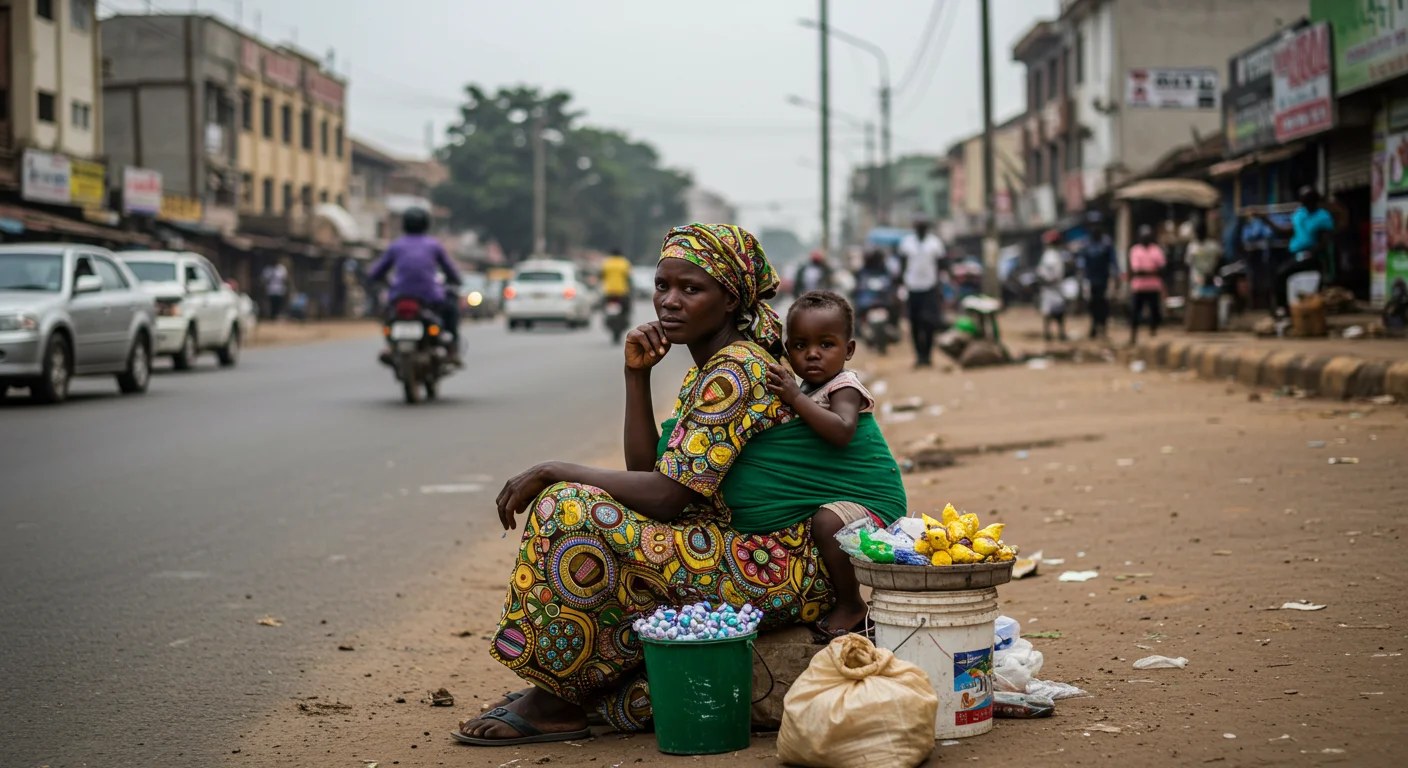
Nigerian families facing economic hardship, representing the millions who struggle daily with poverty while government programs fail to reach those most in need.
Yet, while families scramble to make ends meet, corruption quietly continues. The Nigerian government has fully repaid the $3.4 billion COVID-19 loan from the IMF, which was meant to provide relief during a historic crisis. But much of it was misused. Many funds, intended for millions, enriched a few corrupt individuals.
Warehouses filled with palliatives meant for distribution were discovered. Some looted, some repackaged as campaign souvenirs, others rotted in secrecy. Recently, a prominent Nigerian monarch and his associate pleaded guilty to diverting $4.2 million from COVID-19 relief funds. These are not just financial crimes. They are acts of betrayal.
When public funds are stolen, the woman by the roadside pays the price. She loses access to food, healthcare, and education. She loses her child's future. And yet, she keeps waking up every day, trying to make a living.
The Path Forward
The situation is dire, but it is not beyond redemption. The government must act urgently, not just in word but in deed. We don't need another committee; we need implementation.
Let transparency and accountability go beyond press releases. Let tracking of public spending be active, not symbolic. Let embezzlers be prosecuted, not recycled into new roles. And let every naira spent be felt in the lives of the people it was meant to serve.
This is not about blame. It is about responsibility—the kind that comes with leadership, the kind that listens to the cry of the woman in the sun, holding a child who deserves more.
Nigeria does not have a policy problem. Our problem is implementation.
The government should not be distant from its people. It should touch lives, feed the hungry, educate the young, and protect the weak, not in theory but in practice. Only then can we say, truthfully and proudly, that Nigeria is working for its people.
The Centre for Inclusive Social Development (CISD) is a non-profit research and advocacy organisation working to advance inclusive governance, gender and social equity, civic technology, and sustainable livelihoods across Nigeria and sub-Saharan Africa. Through rigorous research, coalition-building, and public-interest storytelling, CISD amplifies the voices of marginalised communities and holds power accountable.
Learn more at cisdnigeria.org or follow us on social media.
How to cite this article
Folahan Johnson. (2025, August 19). Where Is the Empathy in Government?. CISD Insights. Centre for Inclusive Social Development. Retrieved from https://cisdnigeria.org/article/where-is-the-empathy-in-government-19/.