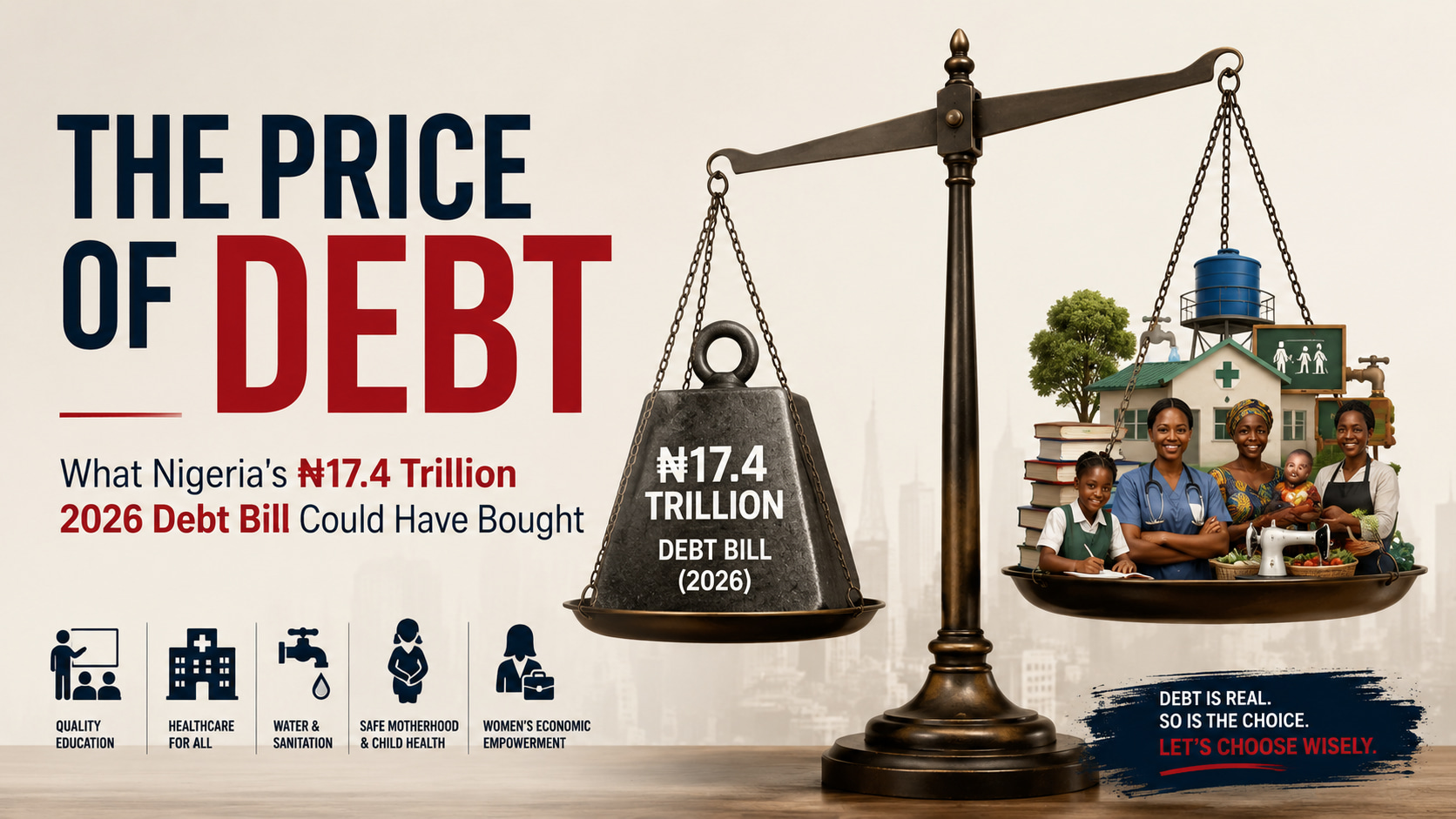
Last week, Nigeria's National Assembly passed what is now the country's largest budget in history, a ₦68.3 trillion appropriation for the 2026 fiscal year. The full details of the approved budget are yet to be published, but the headline number alone tells a story worth pausing on. The figure represents a significant jump from the ₦58.18 trillion originally proposed by President Tinubu in December 2025, after the president sought an additional ₦9.81 trillion to address long-standing financial obligations carried over from previous budgets.
The budget's passage came alongside another development that deserves far more public attention. The Senate approved President Tinubu's request to secure $6 billion in external loans, and did so barely three and a half hours after the letter was presented to the chamber. There was no rigorous public review and no published details of the terms. A multi-billion dollar borrowing decision affecting every Nigerian was concluded in a single afternoon. Former Vice President Atiku Abubakar described this as not just troubling, but alarming, warning that a decision of such national importance cannot be handled with such urgency, and that what Nigerians witnessed reflects a serious decline in oversight responsibility.
Of the $6 billion, the government plans to borrow $5 billion from First Abu Dhabi Bank and $1 billion from Citibank, backed by UK Export Finance. These funds are intended for budget implementation, infrastructure, and the repayment of existing high-cost debts. This means Nigeria is taking on new debt, in part, to service old debt, a cycle that this research examines in detail.
As we await the full breakdown of the approved ₦68.3 trillion budget, this is the right moment to pause and examine the fiscal structure already visible. The figures in the originally proposed ₦58.18 trillion "Budget of Consolidation" were already concerning. The research published below, produced by CISD before the budget’s final approval and increase, breaks down those numbers clearly and simply because this conversation belongs to every Nigerian, not just economists or policymakers.
This is not a story about abstract trillions. It is about where public funds go before they reach schools, clinics, or communities. It highlights a debt burden growing faster than the economy, a naira that has lost more than 75 percent of its value in four years, and a system where only a portion of what is promised is actually delivered.
The approved budget is now larger. The deficit is wider. It is projected to exceed 6 percent of GDP, approximately ₦31.46 trillion, up from an initial estimate of 4.28 percent following the increase. The borrowing continues.
As we prepare our full analysis of the approved ₦68.3 trillion budget, the numbers from the proposed budget already offer important insights. Review the key figures below and understand what Nigeria’s fiscal choices mean for you, your family, and the next generation.
The Centre for Inclusive Social Development (CISD) is a non-profit research and advocacy organisation working to advance inclusive governance, gender and social equity, civic technology, and sustainable livelihoods across Nigeria and sub-Saharan Africa. Through rigorous research, coalition-building, and public-interest storytelling, CISD amplifies the voices of marginalised communities and holds power accountable.
Learn more at cisdnigeria.org or follow us on social media.
How to cite this article
CISD. (2026, April 4). The Fiscal Tightrope: Reading Between the Lines of Nigeria's Growing Budget. CISD Insights. Centre for Inclusive Social Development. Retrieved from https://cisdnigeria.org/article/the-fiscal-tightrope-reading-between-the-lines-of-nigerias-growing-budget/.