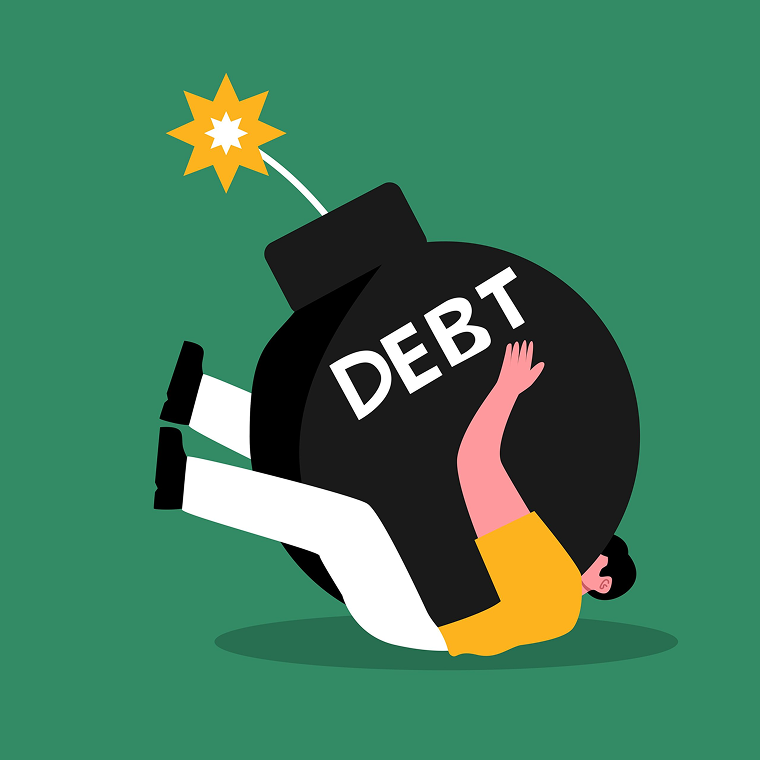
Nigeria's public debt has more than quintupled since 2020. Interest payments alone on domestic debt now consume about 96 kobo of every naira spent on debt service. Capital spending on education, health, youth and women's affairs combined is dwarfed by what the country pays to borrow.
Yet the underlying figures are scattered across government PDFs, quarterly bulletins and press releases that most citizens will never read. When civil society wants to challenge this, or report on it, or build a campaign around it, the first obstacle is nearly always the same: where do the numbers come from, and can I cite them?
The gap is not secrecy — the government publishes a great deal of information. The gap is accessibility. The figures reward patience and expertise, not curiosity.
The Centre for Inclusive Social Development built True Cost of Debt — an interactive platform that publishes Nigeria's public debt figures as charts anyone can read, with the document behind every number named and linked.
Each chart also publishes its own figures as a table and as CSV and JSON, so nothing exists only as a picture. The platform holds what the Debt Management Office, the Central Bank and other institutions have published — and what a member of CISD staff has since checked against the original document.
Where the official figures disagree with each other, the charts say so rather than quietly reconciling them. Where CISD has calculated or rearranged figures, the platform says so explicitly.
The platform is part of the Youth, Debt, Development and Climate Change Project, delivered by CISD with the support of the Heinrich Böll Stiftung.
We started this platform with a simple conviction: that information about public money should be reachable by the people whose money it is.
For every ₦1 Nigeria paid on domestic debt service in 2025, 96 kobo went to interest. Only 4 kobo went to actually reducing what the country owes.
The platform serves three distinct audiences. For citizens, it translates government data into charts and plain language that make debt visible. For civil society, it provides citable data, downloadable datasets and campaign tools. For journalists and researchers, it offers a searchable database of 352 individual loan agreements going back to 1971.
The FOI Letter Builder — a tool that generates legally compliant Freedom of Information Act requests — was designed to lower the barrier for citizens exercising a right most don't know they have. Users pick a template, pick an institution, and the letter writes itself in the exact form the statute requires.
The Fiscal Responsibility Act Tracker monitors every bill proposing to amend the law that sets the rules for how government borrows, spends and reports — giving CSOs early warning when fiscal governance rules are about to change.
Six charts covering total debt, external vs domestic split, debt-to-GDP ratios, creditor breakdowns and domestic debt service — each with its full data table.
A searchable database of individual loan agreements going back to 1971, filterable by sector, creditor, year and level of government.
Five pre-drafted templates for Freedom of Information requests targeting 10 federal institutions — the citizen sends the letter, CISD does not keep a copy.
Monitors every bill proposing to amend the Fiscal Responsibility Act — where it stands in the National Assembly and what it would change.
Every chart and table is downloadable as CSV or JSON. CSOs can drop data into their own reports, models and infographics — no charge, no process.
Every figure cites its source document. When figures disagree, the platform says so. When CISD has rearranged data, that is stated explicitly.
You do not need to trust us. You can check us. Every figure on this platform cites the document that produced it.
When you write a report, prepare a brief, or go on television, the hardest question you will be asked is "where did you get that number?" Every figure cites the document that produced it.
Every chart, every table, every creditor breakdown is available as CSV or JSON. Drop data into your own analysis, models and infographics.
A workflow you can institutionalize — train your interns to use it, embed it in your research methodology, use the audit template to follow up on gaps.
Register as a CSO analyst and subscribe to alerts. When a new loan instrument or quarterly figure lands, CISD sends you an email.
Visit the True Cost of Debt platform to see the data, check the sources, and use the tools — all open, all free.
