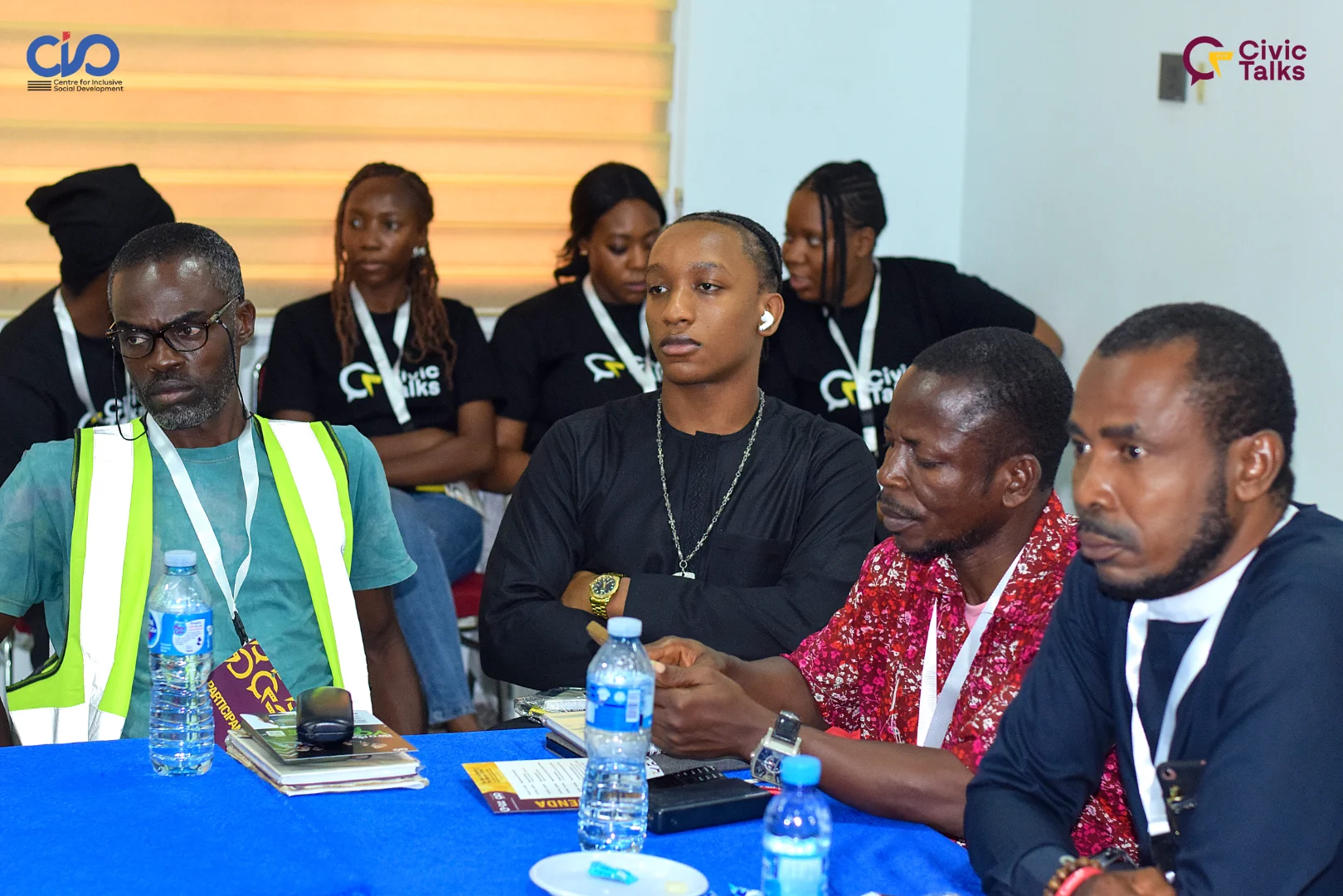
The room did not feel like a policy event. It felt like a confrontation.
The kind where people are tired of guessing how things work and start asking direct questions instead.
What does it really mean to pay tax in Nigeria?
That question sat at the centre of Civic Talks, a forum organised by the Centre for Inclusive Social Development (CISD) on March 12, 2026. The theme, “The New Tax Reform & The Nigerian Citizen”, sounded technical at first. But as the conversation unfolded, it became clear this was about everyday life in Nigeria.
We often talk about tax as something distant. It seems like a topic for accountants, government officials, or big companies. But the reality is that every transport fare, every business payment, every deduction from a bank account carries a piece of it. The real issue is not whether people are paying. It is whether they understand what they are paying for.
In his opening remarks, the Executive Director, Folahan Johnson, framed taxation as a relationship. Citizens contribute, and the government delivers on promised development. On paper, it sounds straightforward.
In practice, it feels incomplete.
The discussions focused on recent reforms, including automation, broader tax coverage, and new systems designed to reduce evasion. There were explanations of relief allowances and how they affect income. For some in the room, it was the first time these concepts were explained in plain terms.
But even as the details became clearer, another pattern emerged.
The problem is not always the policy itself.
It is what happens after.
There is a gap between what is announced and what is experienced. Funds are allocated, but their impact is hard to see. Projects exist in documents but not always in communities. Over time, this creates distance. People begin to comply without connection.
And once that connection is lost, trust follows.
The most striking moments did not come from the experts. They came from the people living within the system.
Com. Wilson Tom Ekat, a taxi driver, spoke about the payments he makes to keep working, like permits, registration papers, and other daily costs. He pays because he has to. But when asked where that money goes, he had no answer. Roads remain in poor condition. Projects stretch on for years. Progress feels slow, and sustainable development feels far-fetched.
He described it as a “snail movement.”
It was not frustration alone. It was confusing as well.
Mrs Oluwatoyin reflected on how young people are increasingly questioning policies and their ripple effect. The days of quiet acceptance are fading. There is a growing awareness that paying into a system should come with visibility, with accountability, with results that can be seen and felt.
This is where the conversation shifted.
From policy to people.
A large part of Nigeria’s economy operates informally, and this reality complicates everything. Many small business owners and workers are not fully integrated into formal tax systems.
So they pay, but not always through the right system.
They comply, but without protection.
The reforms aim to address this by centralising collection and reducing human interference. The idea is to have fewer middlemen and fewer opportunities for exploitation.
But for many, the concern remains.
Will anything actually change?
Formal systems are often seen as complicated and unforgiving. There is fear that stepping into them might increase pressure rather than reduce it. Without visible improvements, scepticism is hard to shake.
This is where the conversation on accountability became practical.
Citizens were introduced to tools and platforms that show how money is spent, documents that outline government projects, and laws that allow people to question irregularities. These are not hidden systems. They are just underused.
If a project is budgeted in a community, what does that look like on the ground? If funds are released, what changes will there be? These are questions that move the conversation from theory to reality.
Another key point challenged is where attention is usually placed.
Many people focus on federal leadership when discussing national issues. But a large portion of public services, including healthcare, education, and infrastructure, are managed at the state and local levels. With increased funding flowing to states, the responsibility at that level has grown. This was highlighted by Mr Iniobong Usen and Mrs Oluwatoyin Olufon.
Yet scrutiny has not kept pace.
Accountability should start closer to home.
The discussion also touched on something less visible but equally important, which is language.
Policy conversations are often filled with terms that feel distant from everyday life. Words like “procurement” or “fiscal policy” can create a barrier. When people do not understand the language, they disengage from the process.
And when they disengage, systems operate without pressure.
Simplifying communication is about opening the door wider so that everyone understands what’s being said.
Civic Talks did not offer a perfect solution. It did not resolve the tension between policy and reality. What it did was create space for questions and for understanding.
It showed that people are not unwilling to participate.
They are waiting to see where their effort leads.
Because at its core, this has more to do with trust than tax.
The final message from the Executive Director to the attendees was to go back to their clusters and spread the message that ‘Tax is a Social Contract’.
A system where people pay without understanding, comply without visibility, and wait without results cannot sustain itself. Over time, questions increase, and expectations rise.
And eventually, the silence breaks.
Civic Talks felt like one of those moments.
Where people began to look at the system more closely and ask:
If we are holding up our end, is the government holding up theirs?
The Centre for Inclusive Social Development (CISD) is a non-profit research and advocacy organisation working to advance inclusive governance, gender and social equity, civic technology, and sustainable livelihoods across Nigeria and sub-Saharan Africa. Through rigorous research, coalition-building, and public-interest storytelling, CISD amplifies the voices of marginalised communities and holds power accountable.
Learn more at cisdnigeria.org or follow us on social media.
How to cite this article
Sadiya Mukhtar. (2026, April 11). What Does Paying Tax Really Mean for the Average Nigerian?. CISD Insights. Centre for Inclusive Social Development. Retrieved from https://cisdnigeria.org/article/what-does-paying-tax-really-mean-for-the-average-nigerian/.